Browse > Home /

Tool of the week for journalists – Pinterest

Tool of the week: Pinterest

What is it? A bookmarking and sharing tool

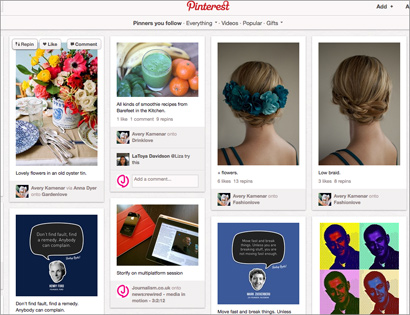
How is it of use to journalists? Pinterest has been growing in popularity recently.

It is a virtual bookmarking system that can be used by newsrooms to curate and share news.

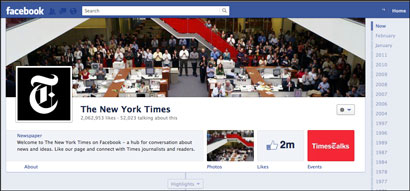
Indeed Liz Heron, social media editor of the New York Times (NYT), suggested at last week’s news:rewired conference that NYT will be joining.

When Heron was asked: “Are there any emerging platforms that NYT are excited about?”

She answered:

Pinterest is one up and coming platform, but we’re still figuring out what the community wants there and how we can deliver something new. You’ll see us there soon.

Journalism.co.uk has since created a Pinterest account and has used it to collate blog posts from news:rewired.

It is invite-only at the moment but we have a handful to share. Email us using this link if you would like one.

Tags: , ,

Similar posts:

#jpod: Lessons from the NY Times and Guardian in managing reader comments

December 9th, 2011 | No Comments | Posted by in Online Journalism, Podcast

The New York Times last week introduced a new category of “trusted commenter”, which it describes as an “invitation-only programme designed for our most valued commenters”.

In this podcast Journalism.co.uk technology correspondent Sarah Marshall speaks to Sasha Koren, deputy editor of interactive news technologies for social media and community at the New York Times; Meg Pickard, head of digital engagement for Guardian News and Media; and Tamara Littleton, CEO of eModeration, a social media management agency that handles outsourced commenting.

The #jpod looks at how the New York Times pre-moderates the majority of comments and how the Guardian post-moderates most of its comments. The podcast also has tips for community managers in encouraging debate, diffusing heated arguments and rewarding readers.

You can also read advice from Tamara Littleton in this guide on how to manage reader comments as a journalist.

You can hear future podcasts by signing up to the Journalism.co.uk iTunes podcast feed.

Tags: , , , , , , ,

Similar posts:

Beet.tv: Why readers watch video on the NY Times and WSJ

December 5th, 2011 | No Comments | Posted by in Editors' pick, Multimedia

Beet.tv has an interview with Ann Derry, editorial director for video and television for the New York Times and Shawn Bender, editorial director for video for the Wall Street Journal online. They explain “why readers click the play button” to watch videos on the two news sites.

Bender feels readers click play in order to feel a connection.

I think that there is a feeling of excitement about the news that you don’t get in the static environment of print that you can get in video.

Derry says that both news sites have had to educate their readers in order to consume news in video form online.

We’ve had to train our users, both at the Journal and at the Times, that if you click on something you get a good experience.

Bender goes on to say that concise videos where the reader/viewer can learn two or three points are the most successful. Derry adds that news video should offer the reader/viewer a quicker, more “efficient” way of accessing the story than if they had chosen to read it as text.

The Beet.tv video is at this link and below.

Tags: , , ,

Similar posts:

Poynter: NY Times introduces unmoderated comments for ‘trusted commenters’

December 1st, 2011 | No Comments | Posted by in Editors' pick, Online Journalism

Poynter has an interesting post highlighting the overhaul of the New York Times’ commenting system.

The news outlet has introduced “trusted commenters“, which the Times describes as an “invitation-only programme designed for our most valued commenters”.

Those who have proved to be trusted by consistently having comments approved will be allowed to leave comments that will be made live immediately without the need for moderation.

Poynter’s Jeff Sonderman explains the overhaul of the NY Times’ commenting system:

The trusted commenter programme is the most significant new feature, in my opinion. Those who join will have to submit and verify real names, a profile photo and hometown by connecting a Facebook account. (Some people object to using Facebook, so other identity verification methods may be supported later, [Sasha Koren, deputy editor of interactive news] said.)

In exchange they get instant commenting, as well as a higher profile on the site. With a special “trusted” logo attached to their color photo and full name, they stand out visually from the other commenters who usually have an anonymous username and no profile photo.

Sonderman’s full post on how New York Times’ overhaul of its comment system and how it grants privileges to trusted readers is at this link.


Tags: , , ,

Similar posts:

NYT: Saddam Hussein ordered killing of Observer journalist, records show

Transcripts of recordings published by the New York Times reveal that Saddam Hussein personally ordered the execution of Observer journalist Farzad Bazoft, who was hanged in Iraq in 1990.

The transcript of a conversation between Iraq’s former leader and the country’s then-foreign minister, Tariq Aziz, reads:

Hussein: We will execute him during Ramadan, in Ramadan, as punishment for Margaret Thatcher.

The documents, which were seized by the US military during the 2003 invasion of Iraq, were yesterday released by the Conflict Records Research Center, a US government archive.

The case of Bazoft, an Iranian-born freelance journalist who worked for the Observer, drew worldwide attention at the time, and the British government appealed for clemency.

The Guardian has more on Bazoft and states:

It appears that even if Bazoft had had British citizenship at the time of his arrest, this would not have saved him.

The document archive reveals the conspiratorial mind-set of Hussein, according to the NY Times, and demonstrates that the Iraqi leader believed Bazoft was an “Israeli spy working for the British”.

The New York Times states:

Even in an age of WikiLeaks, such a detailed record of a foreign leader’s private ruminations is rare.

Tags: , , ,

Similar posts:

#wef11: Publishers share paywall strategies and lessons learnt

October 15th, 2011 | No Comments | Posted by in Business, Events, Journalism, Online Journalism

“Don’t be afraid” – this was just one of many messages given by a panel of publishers at the World Editors Forum today, who shared their experiences of erecting “paywalls” or what came to be termed by the panel as “leaky walls”.

The panel featured three news outlets which have all established paid-content systems in their own ways, although the general approach appeared to be the same, leave holes in the “paywall”.

Dirk Nolde, managing editor of Berliner Morgenpost Online in Germany spoke first, outlining the site’s paid-content model which is free for print subscribers, or 4.90 euros a month. Only some content is placed behind the wall, including local news and sports, which are charged on different models, such as by day or month etc. “Make the assets paid”, he said.

The site also offers a “first-click-free”, such as via Google or social media, which works three times a day. ” We are trying to be leaky with the paywall,” he added.

The results so far is that we have 11,000 digital subscribers which includes print subscribers who can register for free. We thought it would be horrifying but we were wrong, visits went up.

According to his statistics in December 2009, the year in which the “paywall” was set up, visits stood at 2.4 million. In September 2010 this had risen to 3.3 million and last month, in September 2011 it was at 5.1 million.

It didn’t really hurt us, we were able to tell the readers and our users there’s quality behind this paywall.

But he said the site is looking to move to a more metered model.

We will give away more stuff, use a softer approach. It is about being able to accommodate users with the fact we think you should pay for content. That’s our mission.

Fellow panel member, Matus Kostolny, editor-in-chief of SME in Slovakia, discussed how they joined up to the Piano project, a group paywall used by nine news outlets in Slovakia.

The project was set up by Piano Media. I spoke to chief executive of Piano Media Tomas Bella after the panel to find out where the company is going in the near future.

Tomas Bella, Piano Media by journalismnews

The paywall was erected in May this year. On SME it costs 2.90 euros a month or 29 euros a year and, just like Berliner Morgenpost Online, is free to print subscribers. Also similarly only some content is behind “the wall”, such as opinion and political news, the wall is removed for big stories and SME is also considering a more metered wall.

But he added that is is important to remember that “behind stories are real human beings doing real jobs that are worth paying for”.

Public opinion is one of the things we want to influence and we believe it’s so important people pay for it, but if we don’t pursuade enough people then we’ll lose our inflence. We are thinking of different ways to change the structure of paid content and still think that in the end the journalism is worth to pay for and we will pursuade our readers to do it.

Revenue for the first month across all nine sites was 40,000 euros, “which was successful story for our market”, he added.

We were afraid we would lose readers but in the end we didn’t lose anybody, there is an increase of five per cent in unique viitors. We were afraid we would lose readers in locked sections but not losing them so much.

Later he added that one of the biggest lessons is not to be afraid to experiment.

The final speaker was assistant managing editor of digital content at the New York Times, Jim Roberts, who shared some interesting details on the Times’ model, which we reported on here. He told the conference the Times’ pay model is “based on number of principles”.

We try to strike a very delicate balance betwee keeping as open as possible to news junkies, but also really wanted to instill a sense of value for our loyalists who continue to consume quality journalism.

We wanted our regular users to pay. They came to our site and still do, frequently. We felt they understood the sense of value and they would want to pay for it as many of them had done for their print subscription.

Concluding the panel the speakers were asked to share their main lessons. Dirk Nolde gave three which nicely rounded off the session:

  • Communication, communication, communication  – you have to tell users what you are doing
  • This is no supermarket. We’re not selling everything, they don’t have to pay for everything. You have to give things away to accomodate readers.
  • Produce online content that’s really worthy of being paid for. That convinces readers and makes them say “wow that was good”.

Tags: , , , , , ,

Similar posts:

#ONA11: Essential lessons from the Online News Association conference

The Online News Association’s annual conference and awards took place in Boston at the end of last week.

Here is a round-up of the must-read blog posts which will help you sort though the noise of an event that saw 21,000 tweets sent by around 1,200 journalists.

A two-part post by university lecturer Sue Newhook on the top 10 tech trends is one to read and bookmark. It has links to handy tools and news of developing technologies. Part two of the post is here.

There is also a must-read Storify created by Craig Kanalley, an editor at the Huffington Post, with 13 key takeaways told in 13 tweets.

The 10,000 Words blogs has a series of posts, including on how to find and create an awesome web apps team and be a rockstar data developer, on verifying images and information from social media and this guide explaining how to create visual interactives In news time.

One session heard how ESPN and the New York Times build a second screen for readers, which has been documented on the 10,000 Words blog. The post explains the concept of a second screen:

The second screen is literally what it sounds like — the screen readers look at in addition to the TV. This could be an iPad, a laptop or a phone.

According to [Patrick Stiegman of ESPN] stats about Internet consumers, 85 million Americans consume both TV and the web simultaneously. This provides a huge opportunity for news organisations to serve fans in real time, alongside live events.

One particularly interesting area for UK news sites to consider is how the New York Times, which doesn’t control the first screen, competes with eyes for the second screen.

The post explains how Brian Hamman and Tyson Evans of the New York Times  have observed and outlined the cycle for event coverage online:

1.    Event cycle: What’s happening, how much can I get about the event before it happens?

2.    Analysis cycle: When event is started, what does it all mean

3.    Conversation cycle: What are other people and my social circle saying and how can I chime in?
To accomodate for all three cycles of these major events, the best project to point at is The New York Times’ Oscars coverage, which was a dashboard built with three streams.

And the post explains how you can do it all for free:

If you don’t have a team of developers to spend three months building these tools (as Evans and Hammans spent on the Oscars site), there are free tools you can use to achieve the same thing:

  1. Cover it live widget for the realtime analysis
  2. Free Twitter and Facebook widgets for the conversation elements.
  • If you were unable to take a trip to the US to attend #ONA11, you can learn about key developments in journalism at news:rewired – connected journalism, which takes place in London on 6 October.

Tags: , , ,

Similar posts:

New York Times: No Justice for Anna Politkovskaya

Image by openDemocracy on Flickr. Some rights reserved.

Yesterday’s New York Times editorial was devoted to the case of murdered Russian journalist Anna Politkovskaya.

Politkovskaya, who became known for her fearless investigative reporting of social issues in Russia and human rights abuses in Chechnya, was killed in her apartment building in 2006.

Five years on, no one has been convicted of her murder.

From the New York Times editorial:

At the time of her murder, Vladimir Putin, who is now the prime minister but was the president then, dismissed her journalism as “insignificant” and said that nobody “currently in office” could possibly have organized a crime that, he said, was committed “to create a wave of anti-Russian feeling.” To many Russians, that sounded like orders from the top that police or judges or prosecutors should take care not to accuse anyone in power.

Read the full article

Read Journalism.co.uk’s coverage of the case


Tags: , , ,

Similar posts:

Nieman: The New York Times and the kitchen table of the future

The New York Times’ top-floor Research and Development Lab has released a demo video of its latest innovation: a kitchen table. No ordinary kitchen table obviously, it uses Microsoft’s Surface technology to produce a tabletop news consumption experience that departs from the paper’s normal design and layout and has strong social features built in.

See the full demo video below, courtesy of Nieman Journalism Lab, which has a fuller write-up on the table and the New York Times R&D Lab, and transcript of the demo.

New York Times R&D Lab: The kitchen table of the Future from Nieman Journalism Lab on Vimeo.

Tags: , , , , ,

Similar posts:

‘I heard the mechanic click. I knew this is not good’: Joao Silva’s speech

August 30th, 2011 | No Comments | Posted by in Editors' pick, Photography

The New York Times blog today published in full a speech given by photojournalist Joao Silva at the Bronx Documentary Center earlier this month. Silva was severely injured after stepping on a landmine in Afghanistan last year.

Silva lost both legs below the knee, with months of recovery ahead of him at the Walter Reed Medical Center in Washington. Just last month his work returned to the front pages, with an image accompanying a story about the closure of the very medical centre in which he was staying.

In his speech, published in full here, Silva describes that moment in October last year when “everything changed”.

I heard the mechanic click. I knew: this is not good. And I found myself lying face-down on the ground, engulfed in a cloud of dust, with the very clear knowledge that this has just happened and this is not good. I could see my legs were gone, and everybody around me was dazed. I was like: “Guys, I need help here.” And they turned around and saw me on the ground. They immediately sprang into action. I got dragged out of the kill zone, for safety reasons, to a patch of ground a few yards away.

Immediately, there were medics working on me. I picked up a camera, shot a few frames. The frames weren’t very good, quite frankly, but I was trying to record. I knew it wasn’t good, but I felt alive. Adrenaline kicked in. I was compos mentis; I was on top of things. So, I made some pictures. I dropped the camera, then I moved to Plan B, which was to pick up the satellite phone. I called my wife, Vivian, and told her: “My legs are gone, but I think I’m going to live.”

Silva also used his speech to offer advice to young photojournalists keen to enter the field. And the key is perseverance, he said.

It’s not an easy industry. It’s highly competitive. Every year there are literally thousands of young kids coming on the stage, a lot of them so talented. For freelancers, it’s a juggle every day. There’s only so much money going around. There’s only so many publications that will employ people. Even though demand for knowledge and content has grown, the market has shrunk. It’s really sad, but it’s a reality.

As for Silva’s own journey, he said it is likely to be another year before he is “fully functional”, but added that the ultimate goal is to get back to work.

Without a doubt, life is strange. Everything has changed. But I hope to pick up from where I left off, to a certain extent. In the meantime, I just take a little more courage and a little more perseverance and quite frankly, take as many drugs as I can.

Tags: , , , , , , ,

Similar posts:

© Mousetrap Media Ltd. Theme: modified version of Statement