Browse > Home /

#followjourn – @smfrogers Simon Rogers/data journalist

May 4th, 2012 | No Comments | Posted by in Data, Recommended journalists

Who? Simon Rogers

Where? Simon Rogers is editor of the Guardian Datablog and Datastore. Hear him speak about open data in this week’s podcast.

Twitter? @smfrogers

Just as we like to supply you with fresh and innovative tips, we are recommending journalists to follow online too. Recommended journalists can be from any sector of the industry: please send suggestions (you can nominate yourself) to Rachel at journalism.co.uk; or to @journalismnews.

Tags: , , ,

Similar posts:

#Tip of the day from Journalism.co.uk – dive into the data journalism handbook

Any journalist interested in data journalism and improving their skills in this area should take a look at the new data journalism handbook, published this weekend. The handbook started as a draft guide pulled together in just 48 hours at last year’s Mozilla Festival in London.

Contributors to the guide include data journalism experts from outlets including the Guardian, Wired.co.uk, the BBC, the Open Knowledge Foundation and the New York Times. The guide includes advice on finding and using data, with plenty of case studies along the way.

The handbook also states that it “can be freely copied, redistributed and reused under the terms of the Creative Commons Attribution-ShareAlike license”.

Contributors to the Data Journalism Handbook retain copyright over their respective contributions, and have kindly agreed to release them under the terms of this license

Journalism.co.uk runs training courses in data journalism. There are two levels: introduction to data journalism, being held on 9 or 28 May, and intermediate data journalism, which will run on 29 May. Both are being run by Kevin Anderson.

Those looking to expand their skills quickly can book on one of the introduction to data journalism courses and the intermediate course. If you book both options the cost is at the reduced rate. 

This is the last time we will be offering this course led by Kevin Anderson due to his commitments – so take advantage of the final opportunity to learn from this former BBC and Guardian journalist.


Tags: , , ,

Similar posts:

Tool of the week for journalists: Data.gov.uk’s map-based search

Tool of the week: Data.gov.uk’s map-based search

What is it? An option of searching for data sets by geographical location

How is it of use to journalists? Since the launch of Data.gov.uk just over two years ago, and the promotion of open government data, the site has become a go to place for many journalists in search of a data set.

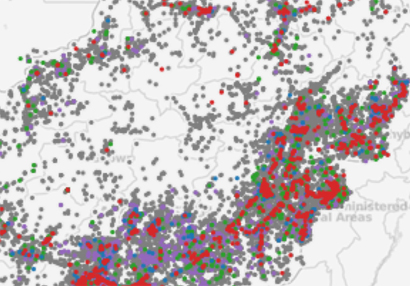
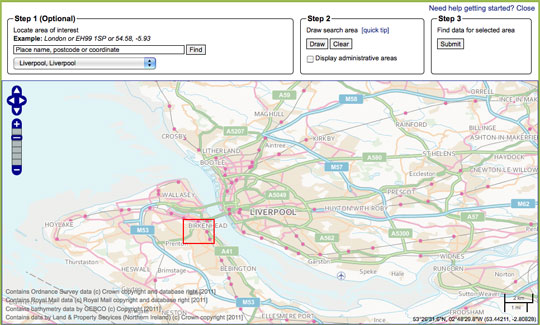
The site now has a map tool which allows you to search for data by location, potentially useful for journalists working on local news sites, newspapers and radio stations.

The map-based search allows you to draw a search area, submit the area and find data relating to that location.

Not tried your hand at data journalism? This guide written for Journalism.co.uk by Simon Rogers, editor of the Guardian’s Datablog tells you how to get a grip with data journalism.

  • Journalism.co.uk also offers a one or two-day course in data journalism, led by Kevin Anderson. The next introduction to data journalism courses are being held on 9 May or 28 May. The intermediate data journalism course will be on 29 May. Those looking to expand their skills quickly can book on both courses, turning it into a two-day course and saving £50 on the course fees.

Tags: , , ,

Similar posts:

#Tip of the day from Journalism.co.uk – publishing data online

December 15th, 2011 | No Comments | Posted by in Data, Top tips for journalists

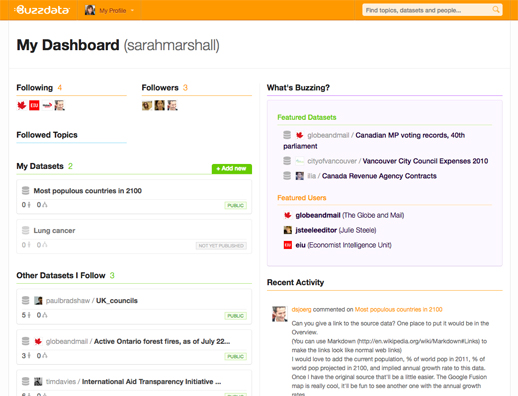
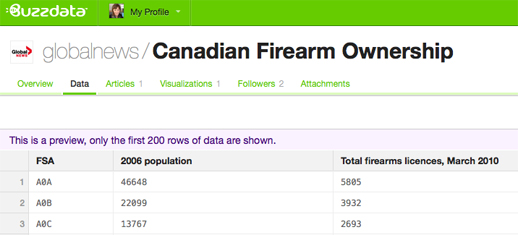
On the Help Me Investigate blog founder Paul Bradshaw outlines four ways data can be published online, which he says can be done “either for others to see the raw material, or to invite them to help you explore it”. His tips include using platforms such as Google Docs or BuzzData. Read the full post here.

Tipster: Rachel McAthy

If you have a tip you would like to submit to us at Journalism.co.uk email us using this link – we will pay a fiver for the best ones published.

Tags: , , ,

Similar posts:

#Tip of the day from Journalism.co.uk – using spreadsheets for data stories

December 7th, 2011 | No Comments | Posted by in Data

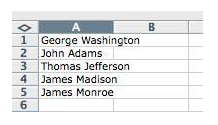
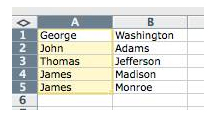
Poynter has a helpful lesson in Excel and other spreadsheet software for journalists dealing with data.

The post explains how to split names in a single column to two columns, for example.

Poynter’s post on how journalists can use Excel to organise data for stories is at this link.

There will be a workshop on data journalism – led by Simon Rogers, editor of the Guardian’s Datastore and Datablog – at Journalism.co.uk’s news:rewired – media in motion conference for journalists. The news:rewired agenda is at this link.

Tipster: Sarah Marshall

If you have a tip you would like to submit to us at Journalism.co.uk email us using this link– we will pay a fiver for the best ones published.

Tags: , ,

Similar posts:

What’s happening to mark open data day

December 2nd, 2011 | No Comments | Posted by in Data, Events

The use of open data in our newsrooms has been growing in the past few years and many people believe that the future of data journalism relies on the collaboration between developers, designers and journalists to create better ways of extracting information from open datasets.

Tomorrow (3 December) is International Open Data Day and there is a series of worldwide events set up to gather coders, programmers and journalists around “live hacking” challenges.

International Open Data Hackathon

Where? The Barbican in London and around the world

When? Saturday, 3 December from 11am

Better tools. More Data. Bigger Fun. That’s how the 2011 Open Data Day Hackathon describes this year’s global event, taking place in more than 32 countries this weekend.

For journalists, it’s an occasion to give hacking a go and meet people from the world of data.

The past year has seen open data continue to gain traction around the world with new open data catalogues launched in Europe, North America and Africa and more data available from organisations such as the World Bank.

Open Data Day is a gathering of citizens in cities around the world to write applications, liberate data, create visualisations and publish analyses using open public data. Its aim is to show support for and encourage the adoption of open data policies by the world’s local, regional and national governments.

Join the Open Knowledge Foundation and CKAN at the Barbican tomorrow (Saturday, 3 December) as they assemble a “crack-team” of coders to break data out of its internet prisons and load it into the Data Hub.

For details about the event, see this blog post, and sign up on the event’s meetup page or by filling out the event’s Google form.

Participants will be on IRC and will also be using the hashtags #seizedata and #odhdLDN on Twitter. All journalists, data scrapers, coders and #opendata enthusiasts can join.

David Eaves, the organiser of this year’s Open Data Hackathon believes this event is a great opportunity to teach journalists, as well as the general public, how to tackle data on a day-to-day basis:

Its a Maker Faire-like opportunity for people to celebrate open data by creating visualisations, writing up analyses, building apps or doing what ever they want with data.

What I do want is for people to have fun, to learn, and to engage those who are still wrestling with the opportunities around open data … And we’ve got better tools. With a number of governments using Socrata there are more API’s out there for us to leverage. ScraperWiki has gotten better and new tools like Buzzdata, the Data Hub and Google’s Fusion Tables are emerging every day.

Who’s it for? Everyone. David Eaves says:

If you have an idea for using open data, want to find an interesting project to contribute towards, or simply want to see what’s happening, then definitely come along.

You can also check out the HackFest 2011 topic page on BuzzData.

London “Random Hacks of Kindness” event

Where? @Forward in London, and around the world

When? 3-4 December 2011, from 9am Saturday until 6pm Sunday

Starting on the same day as the Open Data Hackathon, the Random Hacks of Kindness’ Codesprint will gather thousands of experts in 25 countries to develop open tech solutions over two days of hacking challenges.

The unprecedented gatherings in collaboration with Google, Microsoft, Yahoo!, NASA, HP and the World Bank will bring together some of the world’’ most innovative social enterprises and volunteer technologists.

London’s event promises to be exciting as over 100 tech heads will gather to tackle one issue: financial exclusion and illiteracy. It will be the first ever hack day addressing this theme.

Financial and enterprise education group MyBnk will head a panel of CEOs and IT specialists from LSE, Morgan Stanley, Fair Finance, Three Hands, Toynbee Hall and the Forward Foundation to make major advances in helping young people master money management.

Mike Mompi, head of strategy and innovation at My BNK and the organiser of London RHoK event says:

The main objectives of the weekend are problem solving, capacity building, partnerships, and impact

A £500 cash prize will be given at the end of Sunday for the winning solution (among other prizes) and several media organisations, including The Huffington Post, will be joining in.

People from RHoK have hosted three global events to date, in 31 cities around the globe with over 3,000 participants. Past events resulted in apps and alert systems to warn people of bushfires in Australia and recipients of food stamps to sources of fresh produce in Philadelphia.

The RHoK community is open for anyone to join.

If you want to get an idea of what’s in store for this weekend, check out last year’s hackathon videos.

You will be able to follow the event on Twitter @RHoKLondon and the hashtag #rhokLDN. It is still possible to sign up for this weekend’s free event via this link.

Tags: , , ,

Similar posts:

How open data has changed journalism

December 2nd, 2011 | 2 Comments | Posted by in Comment, Data

Tomorrow (Saturday 3 December) is International Open Data Day. We have been asking what the open data movement has done for journalism.

Simon Rogers, editor of the Guardian’s Datablog and Datastore – @smfrogers

It’s only been a couple of years and you could argue that open data has changed the world: Wikileaks, government spending, what we know about the riots… The irony is that the governments behind much of this data have only contributed the numbers; the hard work has been done by an army of developers and data journalists who have created stories and new ways of telling them. When we started the Datablog in 2009, we thought it would be popular only with developers; now everyone wants to know the facts behind the news.

Nicola Hughes@DataMinerUK

It’s the knowing how to use it that’s vital. it’s a (re)source.

Borja Bergareche@borjabergareche

It’s helped us do the best journalism of the 20th century in the 21st century.

Lucy Chambers, community coordinator, Open Knowledge Foundation – @lucyfedia

Evidence-based journalism. Journalists will back up stories, readers will expect to be able to verify facts.

Andrew Gregory@andrew__gregory

Open data is useful. But original journalism also requires good human sources.

Rune Ytreberg@ytreberg

The obvious: Open data has made journalism more transparent.

Megan Cunningham@megancunningham

Open data has accelerated the opportunities for crowd sourced investigative journalism. But the potential hasn’t been realised.

Harriet Minter@Harriet_Minter

It’s forced journalists to embrace spreadsheets, brought interactives to the forefront and given us many bad infographics.

Greg Hadfield@GregHadfield (who is organising the UK’s first open-data cities conference)

Data – whether open or not – has always fuelled journalism. Data that is increasingly “open” (in the fullest sense of the term) will transform journalism.

Ironically, a lot of the best revelatory journalism of the past has depended on journalists unearthing data (ie “stuff”) that others want to keep locked. Ideally, by lawful means. Therefore, openness may remove some of the mystique that journalists delight in, as people who know things that only those “in the know” know.

An open-data tsunami will mean that more journalism will be about interpreting – and putting into context – data that is open to all, at least in its rawest, unrefined form.

To an even greater degree, journalism will be about adding value to data by transforming it into information. The best journalism will be to add value to information, to provide insight, even wisdom.

Openness of data will change the behaviour of individuals and organisations. But not immediately and not in every case. Would MPs have played fast and loose with their expenses if they knew data about each claim would be published openly and in real time? Sad to say, it is quite possible some would.

Much good journalism has involved shedding light on data that was routinely (although not widely) available and which was only rarely studied or analysed.

Importantly, some of the best journalism has involved making connections and spotting patterns. I’m thinking of earlier parliamentary abuses, such as the “cash-for-questions” scandal of the mid-1990s, before Hansard was on the web, and when it was rarely read in print by journalists.

Those were the days when typewriters and telephones – rather than computers and the internet – were the primary journalistic tools. When bars and restaurants – rather than offices and desktops – were the venues for journalistic enterprise.

With more data openly available – along with more tools easily available for mining, sifting and interpreting it (as in the case of the Wikileaks material) – there are many more needles to be found in the burgeoning haystacks of unstructured data.

But even when every day is #Opendata Day, the best stories may remain hidden in full public view – until one of the new generation of journalists stumbles expertly across them.

Tags: , ,

Similar posts:

Tool of the week for journalists – Playground, to monitor social media analytics

Tool of the week: Playground, by PeopleBrowsr.

What is it? A social analytics platform which contains over 1,000 days of tweets (all 70 billion of them), Facebook activity and blog posts.

How is it of use to journalists? “Journalists can easily develop real-time insights into any story from Playground,” PeopleBrowsr UK CEO Andrew Grill explains.

Complex keyword searches can be divided by user influence, geolocation, sentiment, and virtual communities of people with shared interests and affinities.

These features – and many more – let reporters and researchers easily drill down to find the people and content driving the conversation on social networks on any subject.

Playground lets you use the data the way you want to use it. You can either export the graphs and tables that the site produces automatically or export the results in a CSV file to create your own visualisations, which could potentially make it the next favourite tool of data journalists.

Grill added:

The recent launch of our fully transparent Kred influencer platform will make it faster and easier for journalists to find key influencers in a particular community.

You can give Playground a try for the first 14 days before signing up for one of their subscriptions ($19 a month for students and journalists, $149 for organisations and companies).

Jodee Rich, the founder of PeopleBrowsr, gave an inspiring speech at the Strata Summit in September on how a TV ratings system such as Nielsen could soon be replaced by social media data thanks to the advanced online analytics that PeopleBrowsr offers.


Playground’s development is based on feedback from its community of users, which has been very responsive. Ideas can be sent to contact[@]peoplebrowsr.com or by tweeting @peoplebrowsr.

Tags: , , , , , , , ,

Similar posts:

#Tip of the day from Journalism.co.uk – nine new data tools

August 31st, 2011 | No Comments | Posted by in Top tips for journalists

On his Online Journalism Blog Paul Bradshaw rounds-up some of the latest data-related tools to crop up in recent months. His useful list includes data scraper Junar, data sharing platform BuzzData and data finder DataMarket.

Tipster: Rachel McAthy

If you have a tip you would like to submit to us at Journalism.co.uk email us using this link – we will pay a fiver for the best ones published.

Tags: , , , , ,

Similar posts:

#Tip of the day from Journalism.co.uk – dealing with refusals of FOI requests

August 19th, 2011 | No Comments | Posted by in Data, Top tips for journalists

Chris Dodd came across an exemption he had never seen before after putting in a freedom of information (FOI) request.

Writing in the Help Me Investigate blog, he explained how the Section 44 exemption is the equivalent of “the blue screen of death” because the public body does not need to consider the public interest of the data.

In his post FOI: What is the Section 44 exemption and how can I address it?, Chris looks at ways to address this refusal and various methods of overcoming the hurdles public bodies may put up when denying access to data.

Tipster: Sarah Booker

If you have a tip you would like to submit to us at Journalism.co.uk email us using this link – we will pay a fiver for the best ones published.

Tags: , , , , ,

Similar posts:

© Mousetrap Media Ltd. Theme: modified version of Statement