Browse > Home / Archive by category 'Press freedom and ethics'

#wef12 – WAN-IFRA publishes ‘report on violence against Mexico’s press’

September 5th, 2012 | No Comments | Posted by in Events, Press freedom and ethics

Image by Christian Frausto Bernal on Flickr. Some rights reserved.

WAN-IFRA has this week published a report called “a death threat to freedom”, which looks at “violence against Mexico’s press”.

The report was published on Tuesday (4 September), a day after the organisation’s World Editors Forum presented the Golden Pen of Freedom to Mexican journalist Anabel Hernandez.

The report calls on the government to “take urgent action to guarantee the safety of journalists and media professionals”.

Receiving her award yesterday, Hernandez urged the international community to not “just stand and watch”.

“I do not want to be another number on the list,” she said. “I do not want to be another dead journalist, I want to be one of those who fought to live and who survives.”

I dedicate and symbolically award this prize to all the Mexican journalists whose voices have been silenced by death, forced disappearance or censorship.

I also dedicate it to all those Mexican journalists who daily continue to set an example in their duty to inform and denounce at whatever cost.

Here is a link to her full acceptance speech.

Tags: , , ,

Similar posts:

#Tip of the day from Journalism.co.uk – ethical journalism standards resources

The Ethical Journalism Network, a partnership of organisations including the Global Editors’ Network, the Online News Association and the International Press Institute, has produced a page of resources on its website relating to ethical standards, from news outlet and professional journalism group guidelines, to case studies and regional campaign groups.

Tipster: Rachel McAthy

If you have a tip you would like to submit to us at Journalism.co.uk email us using this link.

Tags: , , ,

Similar posts:

#Tip of the day from Journalism.co.uk – dealing with corrections

All journalists make errors occasionally, but do they all know how to deal with corrections in the age of digital journalism and social media?

At Journalism.co.uk’s news:rewired – full stream ahead conference on Friday (13 July), Craig Silverman, founder, Regret the Error (now published on Poynter) shared his tips for dealing with corrections.

His tips include:

  • Do not delete a tweet
  • Be clear about what was wrong, and the correct information
  • A correction is an act of promotion that builds trust

Here is the must-read list that is well worth bookmarking.

If you have a tip you would like to submit to us at Journalism.co.uk email us using this link.


Tags: ,

Similar posts:

#Tip of the day from Journalism.co.uk – how to ask for data under FoI

At a meeting of Hacks/Hackers Canterbury on Monday, Nicola Hughes, a Knight-Mozilla fellow working at the Guardian, was asked a question about how to best get hold of a spreadsheet containing data when using the Freedom of Information Act.

Hughes explained that if the data exists as a spreadsheet or CSV file, the authority is obliged to make it available.

If a council or public body responds by stating it cannot release the data as some is confidential (details of those in foster care, for example), a request can be made to find out what details are in the database or spreadsheet and the person digging for information can then tailor their request to exclude the confidential information.

Ask for the “schema, name and footnotes” and the relationship between them, Hughes said, and then you can ask for what you are interested in.

For more on how to submit and FoI request see this guide.

If you have a tip you would like to submit to us at Journalism.co.uk email us using this link.

Tags: ,

Similar posts:

#Activateldn: Why Facebook is a key reporting tool for Zimbabwe’s SW Radio Africa

After being fired from one job and finding her house surrounded by Zimbabwean paramilitaries six days after she set up Capital Radio and aired a test broadcast, Gerry Jackson then launched SW Radio Africa.

And Facebook has become a key tool for finding stories, Jackson told today’s Guardian Activate London conference in a talk called “media in exile”.

Jackson spoke of the human rights abuses, corruption and repression in the country, and how the radio station and SW Radio Africa website aim to expose wrongdoings.

She told the conference that Zimbabwe is “trapped” as “nothing changes”.

We are groundhogs [like in the Bill Murray film Groundhog Day]. We are reliving the same day over and over. That’s what it feels like in Zimbabwe.

But although we are groundhogs and do the same stories over and over again, we do highlight stories that rest of the world doesn’t seem pick up on.

Jackson is particularly proud of the radio station’s exposes. The website published a leaked list of the names of 450 individuals who had allegedly committed acts of violence.

The expose received a “huge response on Facebook”, Jackson said. But explained that “people were very frightened to write publicly” so instead messaged the journalist who worked on the story to report details of further atrocities.

The reporters at SW Radio Africa also arrange most of their interviews via the platform. They are also aware that the ruling party “keeps a close eye on Facebook”.

Jackson said around one million people in the country of roughly 12 million are on Facebook, with two million internet connections and nine million mobile phones with 700,000 of those being used for internet access.

It’s impossible to underestimate how much Zimbabweans love Facebook.

She said that not only includes those within the country but Zimbabweans living in exile, which is perhaps one third of the total population.

And key political figures are on Facebook, including members of the Zanu-PF party.

It’s interesting to see their list of [Facebook] friends.

Tags: , ,

Similar posts:

PCC seeks ideas from Irish press regulatory system


The Press Complaints Commission is looking at the Irish press watchdog system as a possible option for reforming the UK self-regulatory approach, according to reports.

Press Council of Ireland chairman Dáithí O’Ceallaigh is quoted by the Irish Times as saying the chairman of the Press Complaints Commission, Lord Hunt, and other senior PCC officials have visited Dublin for a “lengthy meeting” to look at how the Irish press regulatory system works.

The Press Council is part of a two-tier approach introduced in Ireland in 2008. Complaints are first referred to a separate Press Ombudsman, who tries to deal with them through conciliation.

If a resolution cannot be achieved, the ombudsman can make a ruling based on a code of practice and can refer significant complaints to the 13-strong Press Council, which runs independently of government and media.

Mr O’Ceallaigh said:

The fact that they came here at all, and those discussions, reflect the fact that Leveson himself and a number of the witnesses at the inquiry in Britain have already publicly expressed their interest in the origins, the structure and the functions of the Press Council and the Press Ombudsman in Ireland.

Meanwhile, Lord Justice Leveson gave a strong hint yesterday afternoon about the regulatory structure he could recommend when his report comes out later this year.

He discussed allowing group complaints and introducing a “swift” system for dealing with privacy and libel issues without lawyers. Leveson also suggested that an ombudsman could give guidance on whether a newspaper needs to notify the subject of a story before publication.

He said yesterday:

Whatever comes out of this must be independent of government, independent of the state, independent of parliament but independent of the press. It has to have expertise on it or available to it, but must command the respect of the press but equally the respect of the public.

It seems to me that it can do lots of different things. I would like to think about a system that provides redress particularly to those who can’t afford to litigate.

At the moment, the PCC doesn’t take group complaints. So, for example – and I had a number of people giving evidence from, for example, the transgender community and other groups, who say, ‘Well, because there’s no name in this, there’s nobody to complain, and therefore there is no mechanism to obtain redress for them.’

Leveson also said there needed to be “some sort of mechanism to resolve disputes. So that can be consensual, the complaint-solving thing, but a mechanism in the absence of consensual resolution”.

I equally understand that there is an argument that in some circumstances requiring prior notification would lead to litigation and would kill the story. So there has to be some way of drawing a line.

One possibility might be to say there is some mechanism within the regulatory regime that allows the press to say: ‘Look, we have this story, we don’t feel we ought to notify the subject of it for these reasons: he’ll destroy the evidence’, or whatever and to get a view.

If either he doesn’t ask or alternatively he does ask and gets the answer: ‘No, we think you ought to notify’, then again, that doesn’t mean he shouldn’t publish, it’s up to him, but then perhaps there should be a potential regime for exemplary damages. I’m just throwing out ideas.

But then I have another mechanism for swift resolution of privacy, small libel-type issues. Not the enormous stuff, perhaps an inquisitorial regime which can be done without lawyers, but some mechanism for members of the public to be able to challenge decisions and get a swift response.

On top of all that, one has to have a mechanism that means that sanctions work. I recognise entirely the parlous financial position of much of the press, but it’s important that sanctions are taken seriously.

Leveson added:

When I said to [Jeremy] Paxman that I didn’t want my report to end up on the second shelf of a professor of journalism’s study as yet another failed attempt, his only comment was to say: ‘As high as the second shelf?’


Tags: , , , ,

Similar posts:

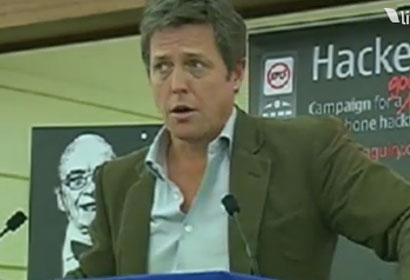
Hugh Grant: Leveson inquiry has shone ‘disinfectant sunlight’ into ‘infected corners’

May 18th, 2012 | No Comments | Posted by in Press freedom and ethics

Hugh Grant, Tom Watson MP and president of the National Union of Journalists Donnacha Delong were among a number of speakers at a rally calling for media reform last night.

The Livestream video embedded below shows the speeches, with Hugh Grant praising the “progress made since last July”.

The first two modules of Leveson inquiry has shone a lot of very disinfectant sunlight into a lot of very infected corners.

He added that he believes the public has started to realise the scandal is “not just about phone hacking but a wider corruption of police and officials and the intimidation elected politicians”.

We’ve been living for the past 30 years in a media-controlled state.

Giving the example of police production orders calling for journalists to hand over journalists’ footage, Donnacha Delong from the NUJ called for a new regulator to define journalists’ rights and responsibilities.

Improved press regulation which details the rights and responsibilities of the press is potentially something we could use to defend the press against from those kinds of illegitimate requests from those in power.

mediareform on livestream.com. Broadcast Live Free

Tags: , ,

Similar posts:

Voice of America: China’s Foreign Ministry questioned on Al Jazeera journalist visa issue

Image by jamiejohndavies on Flickr. Some rights reserved

Voice of America has published what it says is a transcript of questions put to the spokesman for China’s Foreign Ministry, in relation to Al Jazeera English’s report that its China correspondent Melissa Chan had her visa renewal application “refused”.

Journalism.co.uk reported on Tuesday (8 May) that Al Jazeera English has closed down its Beijing bureau after Chan’s visa was apparently “refused” by authorities.

Al Jazeera said in its report “it is continuing to request a presence in China”.

Voice of America has published “a transcript of some of the questions and answers at the Chinese Foreign Ministry’s daily briefing” in which a spokesman is said to have responded to questions from foreign journalists about what had happened.

Hong Lei: I have stressed that China welcomes foreign journalists to report in China and we have also provided convenience to foreign journalists in reporting objectively in China. I think you have been in China for several years and are very clear about this. At the same time I want to stress that foreign journalists should abide by Chinese laws and regulations while reporting in China.

Read Voice of America’s full article here.

Tags: , , , , , ,

Similar posts:

Al Jazeera: Video filmed by Toulouse gunman did not meet code of ethics

March 28th, 2012 | No Comments | Posted by in Press freedom and ethics

Al Jazeera English has said it will not broadcast footage filmed by a gunman who shot and killed seven people in southern France as it does not meet its code of ethics.

Three soldiers, three Jewish children and a rabbi died in the three shooting attacks in Toulouse and Montauban earlier this month. Gunman Mohammed Merah died following a 30-hour siege.

The video, said to have been filmed by Merah and named “Al Qaeda attaque la France” – meaning “Al-Qaeda attacks France”, was reportedly “sent on a USB memory stick to Al Jazeera’s office in Paris”.

The broadcaster said it has passed it on to police.

The report on Al Jazeera’s website states: “The video shows the attacks in chronological order, with audible gunshots and voices of the killer and the victims. But it does not show the face of the confessed murderer, Mohammed Merah, and it does not contain a statement from him.

The network on Tuesday said the video did not add any information that was not already in public domain.

The report adds that Zied Tarrouche, Al Jazeera’s Paris bureau chief, said that “the images were a bit shaky but of a high technical quality”.

He also said the video had clearly been manipulated after the fact, with religious songs and recitations of Quranic verses laid over the footage.

Al Jazeera also reports that French President Nicolas Sarkozy yesterday urged television networks not to broadcast the video and that family members of the victims have asked that the footage not be aired.

Tags: , , ,

Similar posts:

BSkyB CEO confirms he pulled Sky News story on F1

March 21st, 2012 | 1 Comment | Posted by in Press freedom and ethics

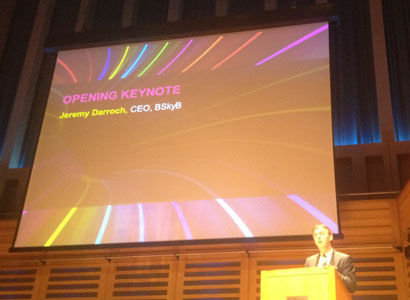
Jeremy Darroch, the chief executive of British Sky Broadcasting, has confirmed that he asked Sky News to pull a story on Formula 1, ahead of the launch of a Sky F1 HD channel.

The Financial Times yesterday reported that Darroch “ordered a news story to be removed from the Sky News website after an executive producer complained that it had upset Formula 1 racing teams”.

“I asked the team to review the story,” Darroch told the Guardian Changing Media Summit, where he was delivering a keynote speech in which he announced the launch of a no contract, pay-as-you-go internet TV service from Sky called NowTV.

He said Sky News “has absolute independence and integrity” but added that “there are times as CEO … when you have to challenge parts of the business”.

Tags: , , , ,

Similar posts:

© Mousetrap Media Ltd. Theme: modified version of Statement