Browse > Home / Archive by category 'Mobile'

Social magazine app Flipboard adds audio

May 16th, 2012 | No Comments | Posted by in Mobile, Multimedia

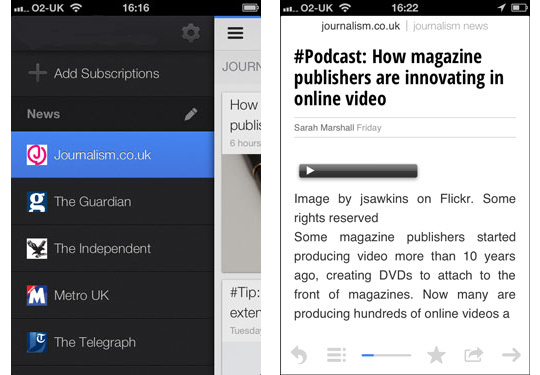
Social magazine app Flipboard has added audio, allowing users to listen to a podcast, an interview or music while flipping through the pages of the app.

Flipboard is an iPhone and iPad app (soon to be on Android) that allows users to sync with their Twitter, Google Reader, Facebook and other accounts to receive personalised news content.

Flipboard has partnered with SoundCloud for audio (which provides content including Journalism.co.uk’s podcasts), National Public Radio and Public Radio International (PRI).

As The Next Web reports:

It’s a marvellous new way to distribute and listen to audio content, one I might just use specifically for podcasts. The user experience is unquestionably superior to iTunes.

And how long before we see Flipboard dive into video? It’s somewhat surprising it hasn’t decided to explore the video space first. The social magazine already includes a video category but is limited in sources and isn’t ideal for video browsing. With no clear winner in the video magazine space (see ShowYou and TNW Startup Rally winner Shelby.tv), Flipboard can still make it its own.

BBC News and TechCrunch both have details on the Flipboard development.

Tags: ,

Similar posts:

The future of video journalism: What will audiences be watching?

May 16th, 2012 | No Comments | Posted by in Events, Mobile, Multimedia


Still from 1929 film Man with a Movie Camera
en:Dziga Vertov [Public domain], via Wikimedia Commons

I was asked to give a talk to a BBC Global Video away-day on the future of video, looking at what their audiences will be watching in the coming years.

The Global Video department was launched last year and makes video to run cross-platform in multiple languages on all the BBC’s Global News outlets: World News, BBC.com and 27 World Service language services. The team never makes a video just for one language or site, changing the voiceover and translating the film into two or more languages.

The future of video journalism

Below is an outline of the talk I gave on the day:

What will audiences be watching?

There are countless examples of innovations in video journalism, including many from the 40 videos a week produced by Global Video.

Here are a few examples of trends in online video journalism and innovations using emerging technologies.

Documentary:  Just as long-form journalism has a place in the digital sphere, so too do long-form video documentaries using TV and cinema conventions of storytelling.

For example, here is the Guardian’s 32 minute ‘I will never be cut’: Kenyan girls fight back against genital mutilation, which recently won a Webby award.

Web native: As online video has developed, it has found its own style and some filmmakers are telling stories using a new set of rules. Multimedia producer Adam Westbrook has written many articles arguing for online video to encourage subjects to look directly at the camera, abandon the “noddy” (the way video often hides an edit by showing a clip of the interviewer nodding) and instead add a flash to white or black, acknowledging the edit to the viewer.

Storytelling: With the advent of online came new storytelling techniques such as audio slideshows, graphics and ways of visualising data. The BBC Global Video unit has its own fantastic examples, including this video made by Tom Hannen using Adobe After Effects and brilliantly telling the story of blood doping.

The Economist too is experimenting with storytelling in words. Here is an example.

Videos filmed on small, cheap cameras: The Global Video unit itself is equipping its journalists in the field with video news gathering skills. Elise Wicker from the department has written about how she has been training staff overseas to use Kodak cameras to capture footage.

Here is an example of an Al Jazeera documentary filmed entirely on an iPhone. Syria: Songs of defiance is a first-person film made by a journalist who spent many months in Syria but could not risk being seen with a video camera. This film, complete with time lapses shows how a great film can be made in the process of the edit.

Contextual video: Advances in web browsers allow new possibilities. Here are three examples made using Popcorn JS, a JavaScript open-source library from Mozilla allowing video to link to real-time web content such as tweets, Google Maps and Wikipedia entries.

History in the Streets is an audio recording uploaded to SoundCloud with locations linked so that when the audio refers to a place, the viewer is taken to that location on Google Street View and can navigate and explore.

Open Images, Open Data is a Dutch film showing a video surrounded by real-time links to content from several sites, including Wikipedia.

This example of a film about freedom of the press in France links to the source documents, demonstrating how journalists can link to data or research to back up a claim.

Development of Mozilla’s Popcorn Maker tool could allow video journalists without coding skills to produce similar video.

How will audiences be finding and sharing content?

Social sharing is key to the future of video and the format lends itself to a social experience with YouTube demonstrating how videos can go viral.

Social is overtaking search as a way to discover content. Facebook overtook Google in March as a traffic driver to the Guardian, largely down to the news outlet’s “frictionless sharing” Facebook app.

New audiences will be finding and frequently watching video on social networks, whether they be Facebook, Twitter, or Chinese site Renren.

Video is often a component of a wider narrative too. Storify is a free tool allowing anyone to curate a story by dragging in tweets, Flickr photos, SoundCloud audio and video from YouTube and Vimeo.

And platforms such as Storify, YouTube, Vimeo, Bambuser, and many more have their own communities and networks too.

Here is an example of what Mark Boas, one of the Knight-Mozilla Fellows, is doing. He is embedded within the newsroom of Al Jazeera and looking at how you can socially share content without detracting from the experience of viewing a video.

Boas told me that part of what is driving this is social, partly the second screen, partly web-enabled TV, partly browser technologies.

He is experimenting with social sharing text from within The fight for Amazonia. Content is pulled live from a Google Doc, he explained.

Writing on his blog, Boas describes the possibilities of social.

Technology is available now to allow people to chat and comment over the web. Certainly this is an experience we could build in. Imagine if you could see all the people currently watching the same programme as you and interact with them.

Boas believes this social layer is key but that it should not “significantly distract from the main content”.

He thinks the social experience benefits from integrating existing social networks and will “perhaps create new ones surrounding the video medium”.

People like to share their experiences in general and this certainly seems to hold true of video and media in general.

He has ideas for future implementations, including “the use of word accurate hyperlinked transcripts, full support for mobile devices and second-screen synchronisation.”

In an email Boas told me:

I think many like me are experimenting just now. I myself am very interested in making experiences that don’t distract too much from the principle act of watching video but I feel that the challenge here is to allow the viewer to choose the level of interactivity and make that choice as plain as obvious and seamless as possible.

3. What will people be watching video on?

Web-enabled TV: Web technologies and television are converging with the advent of web-enabled TV.

The New York Times earlier this month asked “Why can’t TV navigation be more like a tablet?” That looks likely with the next generation of viewing options, including video on demand available on games consoles and an increasing number of TV apps.

Web-enabled TV is expected to offer users an experience more like navigating using a tablet, with viewers able to control the screen by a series of touch screen gestures and swipes.

If rumours of the new Apple TV are to be believed, this may take the form of a Siri voice-activated TV made by Apple (a later development than Apple TV, a box which is plugged into a regular TV to stream iTunes content).

It is also reported that set-top manufacturer LG will be offering televisions with Google TV later this month, with features including voice activation, the ability for viewers to watch video-on-demand content and web videos and control of content by touch screen and swipes.

Google TV will also allow friends or contacts in different locations to watch video together as it will incorporate Google Hangouts, the Skype-like video option from Google Plus.

Desktops/laptops: BBC Global Video’s audience may access content on different connections than those that spring to mind when you first think of web video.

The number of home broadband connections are low in some of the countries covered by the 27 language services, with large proportions of audiences connecting with dongles and other 3G connections in some countries. Video may be easier to stream on a 3G connection at certain times of the day, and impossible at busier times.

Audiences may also use proxies to circumvent internet restrictions in countries such as China, which can give a slow connection.

Tablets: Tablets are increasingly popular in some of the countries served by BBC Global Video, and take-up is low in other countries.

Whether they become an important platform in poorer countries remains to be seen but there is no doubt that they have already become important for more affluent audiences.

And tablets can provide a beautifully tactile viewing experience, with readers encouraged to use the touch screen to play a video embedded within a news story.

Mobile: The popularity of mobile and likelihood of possibilities for video viewing should not be ignored.

It is worth noting that 87 per cent of the world population has a mobile phone, compared with just 8.5 per cent having fixed broadband. According to stats on Mobithinking, there are 5.9 billion phones compared with half a billion fixed broadband connections.

In Jordan the number of mobiles exceeds the population with 6.2 million phones to 6 million people, according to Ayman Salah, a technology expert based in the Middle East.

In Egypt there are 74 million mobiles for a population of 84 million, Salah said, with mobiles being introduced commercially in 1997. That compares with 11 million landlines, first introduced almost 100 years ago in 1920.

The BBC World Service sites and BBC.com are well served by mobile sites that recognise the phone type and format video accordingly.

But of course mobiles are not all Androids, BlackBerrys and iPhones. Smartphones are less common in poorer countries, and different brands dominate. According to the Economist, Nokia ranks with Coca-Cola as Africa’s most recognised brand.

So what is the future of video in Africa if smartphone penetration is low? I asked mobile expert Peter Paul Koch (also known as PPK online).

“Don’t focus too much on smartphones,” he warned.

Today’s feature phones are getting more and more functionality, and I wouldn’t be surprised if they add video in the near future. The line between smartphones and feature phones is blurring, and pretty soon we’ll see “feature phones” (as in cheap) with “smartphone” functionality.

And video is growing on mobile. Cisco predicts that two-thirds of the world’s mobile data traffic will be video by 2016.

Mobile video will increase 25-fold between 2011 and 2016, accounting for over 70 percent of total mobile data traffic by the end of the forecast period.

Mobile is intimate. It is in your pocket, it is personal and is there when you have a spare five minutes to watch a web video.

What is the future of video? With a growing trend in social sharing, an ever-expanding range of devices and internet connections, including to mobile, the future is bright.

Tags: , ,

Similar posts:

#Tip of the day from Journalism.co.uk – iPhone photography advice

With journalists often turning to their iPhone to capture images to illustrate a news story, here are some tips collected by the International Journalists’ Network, based on the advice of Cindi Hobgood, founder of Scout Photo Expeditions.

See the IJNet list here.

Tags: , , , , ,

Similar posts:

Tweetbot partners with Storify to allow Twitter conversation sharing

Tweetbot, a Twitter client app for iOS and a previous Journalism.co.uk app of the week, has added Storify integration.

Users of the iPhone and iPad Tweetbot app can now easily Storify a conversation they spot on Twitter.

There is no need to move away from Tweetbot to Storify, a tool to allow the curation of social media content, all is done with a swipe and three taps within the app.

Just swipe right on a tweet that is part of a conversation, tweet the conversation and it is automatically Storified.

If you don’t have a Storify account one will be created.

The 2.3 update was released yesterday. Those with the app can update, new users can download from the App Store for £1.99.

Here is a Storify explaining how it works.

Tags: , ,

Similar posts:

When HuffPo UK found an iPhone more useful than a newsroom

April 30th, 2012 | No Comments | Posted by in Mobile

On Friday the Huffington Post UK offices were evacuated due to a three-hour siege that closed Tottenham Court Road.

When journalists found themselves 100 yards from a breaking news story, they “grabbed phones, though sadly [they] didn’t grab chargers and laptops” and went into to the street, the title’s executive editor Stephen Hull told Journalism.co.uk.

Hull used his iPhone to share pictures and videos from the scene, adding 5,000 followers to his Twitter account in the process.

He posted videos taken on his phone on YouTube, including one of a woman called Abby who was the target of the attack.

The videos went viral, receiving 32,000 and 200,000 views respectively and were picked up by mainstream TV broadcasters.

Hull told Journalism.co.uk:

One of the great things about the Huffington Post is that we can run the entire website from our bedrooms.

We had staff working at home who were due to come in later in the day. They were able to pick up the running of the site and update the front page with splash images.

Hull’s Storify detailing the process is available here.

Tags: , ,

Similar posts:

Storify stories now on news reader app Pulse

April 19th, 2012 | No Comments | Posted by in Mobile, Social media and blogging

Curated storytelling tool Storify has partnered with news reader app Pulse.

The move marks Storify’s first syndication deal and sees curated stories by Storify users such as Al Jazeera’s the Stream, the Washington Post and the White House communications team available on the social newsreader app.

Pulse, which is available for the iPad, iPhone, Android, Kindle Fire and Nook, allows readers to chose to add their favourite news providers and feeds giving a personalised reading experience.

A Storified blog post by the company explains how to add your Storify creations to your personalised Pulse app.

You can also see your stories – or any account’s stories – on Pulse by subscribing to the RSS feed at the top of Storify profile pages. Then call the feeds up from Google Reader on Pulse. You’ll be able to see all those accounts’ stories on Pulse from then on.
For more on the syndication deal see this Storify.

Tags: , , , ,

Similar posts:

#Tip: Follow Sky News reporter in using Bambuser to livestream video

March 30th, 2012 | No Comments | Posted by in Mobile

Here is an idea for all journalists: use Bambuser to broadcast a livestream video from your phone.

The app and mobile site allows you to stream video from no less than 360 mobile phone models.

Sky News North of England correspondent Nick Martin yesterday used his iPhone to livestream a report on queues at fuel stations.

It wasn’t broadcast live or aired later on Sky news on this occasion but enabled Martin to share live footage with his Twitter followers. A total of 45 watched it live, with current viewer stats standing at 443.

He told Journalism.co.uk:

We’ve been covering the fuel problems at forecourts across the country.

It was just a case of going past a forecourt and seeing pretty lengthy queues of 50 or 60 cars and not having a cameraman with me.

It’s a way of getting pictures in real time to Twitter followers or to a news desk.

The quality sometimes isn’t great but a way of people being able to plug into what you’re doing as a reporter.

Martin said he saw real value in the possibilities during a breaking news story, such as the riots, of the channel broadcasting the phone footage live.

Martin explained that Sky News has its own technology to allow reporters to sent high quality phone video footage to the newsdesk.

Hans Eriksson from Bambuser told Journalism.co.uk:

Bambuser has been used by several smaller local media outlets in the UK over the last year but this is the first time it’s been used this way by a nationwide media.

Bambuser is a previous app of the week for journalists.

Nick Martin spoke about his innovative uses of apps at last month’s news:rewired conference for journalists.

Here are Martin’s three pieces of advice for journalists considering using mobile phones for reporting. The liveblog of the session is at this link.

Tags: , , ,

Similar posts:

BBC News launches ‘responsive’ site as 26% of hits come from mobile

March 28th, 2012 | 1 Comment | Posted by in Mobile

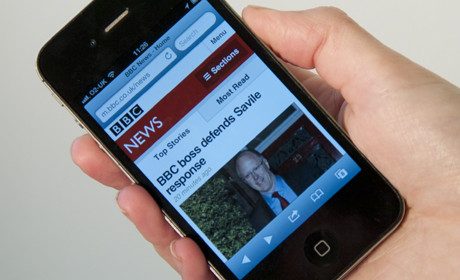
BBC News this week released a “responsive” site aimed at mobile which automatically scales to fit the device it is viewed on.

It can be viewed at m.bbc.co.uk/news.

More than a quarter of hits on BBC News come from mobile, including via apps and the mobile and desktop sites which are accessed via a browser, rather than desktop, according to a post on the Editors blog.

In an average week, for example, the BBC News site and apps are visited by about 9.7 million users on mobile and tablet devices worldwide, or about 26 per cent of total users to BBC News Online.


Writing on the blog, Steve Herrmann, editor of the BBC News website, states:

This new site is designed, for now, mainly for simpler phones, although you should be able to access it on any device. It will gradually evolve as new features and functionality are added in coming weeks, to the point where it becomes the default browser for smartphones as well.

Kate Milner, mobile product manager for BBC News writes on the Internet blog:

We’ve made it easier for you to skim through the news headlines and view the ‘most read’ articles. Features and analysis stories are also now showcased throughout the site.

We’re improving our coverage of live news stories for all mobile users. The live page format offers short form updates related to big stories as they unfold, for example on stories like the Budget and global news events.

She goes on to say “over the coming weeks and months we’ll be adding more features and functionality”, including video for those devices that can display it.


Tags: , , ,

Similar posts:

Guardian launches Streetstories, an app for King’s Cross

March 21st, 2012 | No Comments | Posted by in Mobile

The Guardian has launched Streetstories, an iPhone and Android app, providing audio stories based on the phone’s location.

The app is another Guardian project focusing on social, local mobile and is launched the day after the public release of n0tice, another move by the news organisation into the SoLoMo space.

Launched ahead of the Guardian’s Open Weekend event this weekend, the Streetstories app provides a guide to King’s Cross,the area of London where King’s Place, the Guardian building where the event will take place, is located.

Francesca Panetta, the app’s creator, has blogged about it.

Streetstories is a free app for iPhone and Android which triggers audio relevant to your location - your smartphone knows where you are, and plays the stories automatically. The way the app works is you plug in your headphones, start up the ‘autoplay’ mode and put your smartphone in your pocket. The app will find where you are and start playing the clips, so you don’t need to press any buttons, just wander anywhere in the area and your route will create your own narrative

Tags: , , , , , ,

Similar posts:

Guardian hyperlocal platform n0tice now open to all

March 21st, 2012 | No Comments | Posted by in Hyperlocal, Mobile

The Guardian’s latest venture into hyperlocal publishing is now open to all with the “full open release” of n0tice.

Matt McAlister, director of digital strategy for the Guardian Media Group, presented the social, local, mobile offering at today’s Changing Media Summit.

The seed of the idea came out of a Guardian Hack Day project inspired by geolocation services.

McAlister explained the concept to Journalism.co.uk, which has tracked the progress of n0tice:

If the phone knows where you are and if I see something interesting around me, why can’t I report on that and be an active citizen journalist or participant?

The team evolved the idea into “a community service explicitly tied to a location, almost as a navigation or a filter for finding information”.

Since accepting members by invitation only, early users have been influencing its development.

The platform has opportunities for hyperlocal news sites, which can brand a noticeboard, tracking interaction using web analytics.

Some hyperlocals have adopted n0tice as “their events database, essentially submitting events directly onto notice but with their brand and look and feel”.

McAlister explained that it can increase engagement for hyperlocals.

WordPress is a wonderful publishing environment but it’s not as good as crowdsourcing reports. You can get someone to comment on something you’ve written but it’s not as good for letting anyone share anything original directly into a community space.

The platform also has wider opportunities for hyperlocals and other users: they can potentially make money by creating a noticeboard.

Based on a classifieds system with users paying for premium ads, noticeboard owners keep 85 per cent of the revenue generated.

Here Matt McAlister explains the project’s development:

Tags: , , , ,

Similar posts:

© Mousetrap Media Ltd. Theme: modified version of Statement