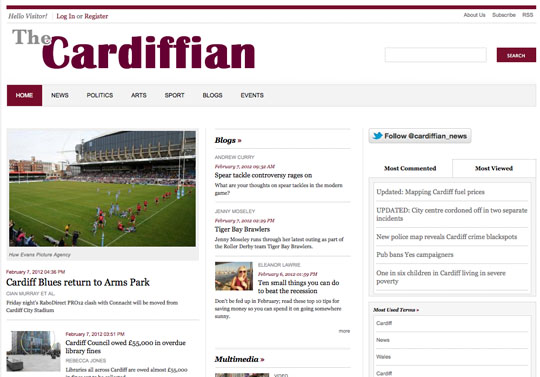
Trainee newspaper journalists from Cardiff School of Journalism have relaunched the Cardiffian, a hyperlocal.
One of those involved, Tom Rouse, explains how it is run.
The news site is staffed by trainee newspaper journalists at Cardiff School of Journalism. With 29 reporters, each assigned their own patch, we are able to cover a large part of Cardiff at a ward level and cover a depth and breadth of stories which engage with communities on their own level.
The site was originally set up for last year’s students, so our focus this year has been reviving a site which has lain dormant since April and rebuilding ties with local community groups. This background means we have not had to build a readership from scratch, but has presented a different challenge in ensuring we offer something different from what is already out there.
Fundamentally, the Cardiffian is a news site and a chance for us to put our work in a real world setting. The majority of our second term is dominated by our first efforts as journalists in sourcing stories and producing a paper. As this paper is produced as a training exercise it allows us to make mistakes in a safe environment. Putting our work up on the Cardiffian builds upon this by giving us an invaluable opportunity to gain feedback from readers about the stories we’re writing and understand what works when presented to an audience and what doesn’t.
But, we are hoping to make the site far more than just another source of news in Cardiff. We want to fill the niche in the local online community which was left vacant by the demise of Guardian Cardiff and act as a hub for a variety of content, not just our own.
This means a large part of our strategy revolves around making ourselves useful to communities and encouraging them to engage with the site, whether that means submitting their events to our listings page or writing a guest blog on an issue they feel passionately about. We are hoping to build a genuine two-way relationship with our readers,
Glyn Mottershead, lecturer in digital journalism at Cardiff University, said:
The key point of the site is to help our students learn about the ways in which the industry is changing, to understand content and community strategies and build a living portfolio of work.
It is also an opportunity for them to engage with groups in Cardiff and try and help them get their message out.
The first year was very much a news site, which worked well in its run and received good feedback. This year is more about involving members of the community in the site and trying to understand and support an online community that is interested in what is happening in the city around them.
The site is also a bit more of a lab than other parts of the course and gives the students the opportunity to explore ideas that may be of interest to the community and suggest changes to platforms and strategies based on genuine feedback from them.
Sarah Hartley, a community strategist for the Guardian Media Group and part of the team behind its online noticeboard n0tice, is to join community media project Talk About Local as its interim managing director next year, according to an announcement on the site.
The post adds that she will continue to head “the community strategy for n0tice.com” but will also help with “exciting new initiatives in the pipeline” for Talk About Local, which was set up by William Perrin.
In a quote Hartley said:
I am delighted to be starting 2012 tackling some new challenges working alongside the talented and dedicated team at TAL.
We have some exciting new initiatives in the pipeline, helping people find their online voice for communities, as well as continuing to be active in supporting and promoting the many blogs and websites we are already involved with.
CNN this week unveiled its new iReport site which, according to a blog post about the changes, will offer greater personalisation, an enhanced community through “groups” and a “favourite button”.
iReport is CNN’s platform for user-generated content, where non-journalists submit video stories, the best of which are broadcast on the news channel.
The update comes five years after iReport was launched and, according to CNN’s post, now has a community of “nearly a million people”.
Last month at news:rewired – connected journalism, CNN digital producer Dominique van Heerden shared some interesting statistics on iReport, such as that CNN had published 912,000 iReports since its launch, with 15,000 iReports published on average every month and 2.4 million unique users in June 2011.
In an article on the new version iReport, lostremote’s Natan Edelsburg said the aim was “to create the largest ‘social network for news,’ according to Lila King, participation director at CNN”.
The BBC this week launched its 2012 Community Reporters scheme, according to an article by in-house magazine Ariel, which will see the trainees ultimately get the chance to pitch an idea to BBC London.
According to the report the 18 trainees include “a minicab driver from Brick Lane, an artist from Hackney and a Marylebone youth worker”.
The new recruits, who are actively involved in their communities and have no paid broadcasting experience or qualifications, will get six days of advice from experts across the BBC, including the College of Production, CoJo and journalists at BBC London.
They will then pitch their ideas to the BBC London editorial team, who will choose which ones to develop for broadcast in a week of production in December.
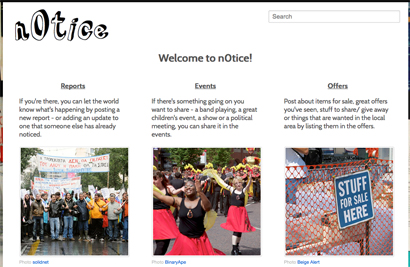
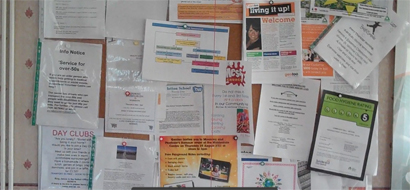
The platform is an online version of a village noticeboard, allowing people to post and find community news and classified ads. It is location-based, enabling searches and delivering news related to any location worldwide.
Guardian News & Media plans to make money out of the site, which was inspired by a hack day, by charging for featured ads and selling the white-labelled technology to companies wanting to use n0tice for commercial purposes.
The platform has a read API, a self-serve white label version and feed importing meaning that it can be adapted for hyperlocals and “could potentially work just as well for hyperlocal community bloggers in northern England as it could for cricket fans in India or birdwatching groups in Oregon”, Sarah Hartley, community strategist at GMG and one of a team of three working on the project told Journalism.co.uk.
Matt McAlister, director of digital strategy at the Guardian, has announced the latest developments in a blog post:
The release today is a big one for us. We’ve added the ability to create your own n0ticeboard.
He goes on to say:
If we can make citizen journalism possible in more contexts for more communities then I think we will have done a good thing. If we can also make citizen journalism a financially sustainable activity then we will have done a great thing.
As we go along we are increasingly unsure of what happens next. Participants are starting to determine what we do more and more. So, if you want this platform to do something, please get in early and share your thoughts with us.
The platform is in still private beta so invite-only, but Journalism.co.uk has 10 invites. You can try to claim a n0tice invite by clicking here.
Operating systems: Apple (iPhone, iPod Touch and iPad). Requires iOS 4.3 or later
Cost: Free
What is it and how is it of use to journalists? Teleportd was released earlier this month as an app as the “closest thing to teleportation”, transporting you anywhere in the world by allowing you to see photos taken on mobile devices shared on social media, including Twitter, Facebook, Foursquare, Instagram and PicPlz.
You can explore photos shared near you or see those taken anywhere in the world by using the map and see images being shared in real-time.
It is a fantastic app which promises consumers a pictorial insight into a news story as it breaks. As a journalist you can see what photos are being shared, which could provide a possible library of images (remember, you must seek permission to use pictures – if in doubt read this guide explaining how to know when to use photos from social media) or you can use the app to view photos from a huge number of sources which could potentially contribute towards your verification process when faced with a breaking story.
The first screengrab here is of the photos being shared in real-time in Brighton (where Journalism.co.uk is based); the second is of images being shared in Tripoli, Libya.
Reviews: Apple has not yet received enough ratings to display an average.
Have you got a favourite app that you use as a journalist? Fill in this form to nominate an app for Journalism.co.uk’s app of the week for journalists.
Six months ago the Guardian Media Group called time on its regional news pilot Guardian Local, but it is continuing to experiment in the local market, its latest venture being n0tice, a location-based online notice board to share and read news and notices.
The hyperlocal website and mobile site is currently in private beta, with a team of three at GMG along with an army of contributors helping to shape the online version of the village notice board. Others who want to get involved will soon be able join.
n0tice was born out of a Guardian hack day and has SoLoMo, a trend towards social, local and mobile, at its heart, but as it does not currently have Guardian branding it feels more like an independent start-up than a child of the news outlet.
The platform is a space for people to buy and sell, like the classifieds section of a local newspaper, and can be used for general notices, local news and liveblogs or updates posted by citizen reporters as community news breaks.
It is like a reverse Foursquare, where rather than checking in to a business or venue, you allow your computer or mobile to grab your location information and the site finds the community groups, items for sale and news near you.
How is it going to make money?
Listing on n0tice is free but users get the option to pay for a featured post. Pricing is yet to be confirmed but the figure currently being worked with is a charge of £1 for each mile radius from the seller’s location per day.
The site, which can be used worldwide and white labelled, will be given free to hyperlocals and sold to commercial ventures, such as anyone who wants to use the technology to set up a location-based site, according to community strategist at GMG Sarah Hartley, who was head of online editorial at the Manchester Evening News and later launch editor of the now defunct Guardian local experiment.
And of course, being a Guardian platform, it has an open API.
Along with Hartley, who this week spoke about n0tice at the Brighton Future of News Group, two others are working on the development of the platform: Matt McAlister, who is director of digital Strategy (who in May announced n0tice with this thorough explainer) and developer Daniel Levitt (whose blog is here).
One of the areas the team is looking into is how to best reward users who contribute, with a current system in place of an ‘Editor’ badge which goes to the first user in an area.
The next round of users will be invited into the platform soon soon, with a planned release of the site next year. You can sign up to be one of those by entering your email address here, you can follow @n0tice on Twitter and get involved by joining this Flickr group and “celebrate noticeboards” by contributing photographs.
Citizen journalism breaking news site Blottr has launched in France in and is due to follow with a German site next week.
Blottr, which launched in the UK in August 2010 and received £1 million in funding to expand six months ago, relies on a network of more than 1,000 citizen reporters, non-professional journalists and bloggers who report on breaking news and provide comment and get paid by how many clicks their story receives.
The official launch of the French site, which will focus on Paris, Lyon and Marseille, takes place in Paris today; the German site, with news from Berlin, Frankfurt, Hamburg and Munich, is due to go live next Monday (24 October). Blottr aims to expand into 50 cities in 10 countries within the next six months.
Country managers from France and Germany have been brought in to lead the French and German sites, both working from the London office, which now has 12 paid members of staff.
The UK site has citizen journalist contributors in eight cities – Birmingham, Bristol, Cardiff, Edinburgh, Leeds, Leicester, London and Manchester – and totals 1.4 million unique users a month in the UK, growing around 20 per cent month-on-month, Jerry Boston from Blottr told Journalism.co.uk.
Blottr founder Adam Baker said:
We are really excited about bringing citizen journalism to France, a country with a deep-rooted, passionate and traditional set of values when it comes to publishing and the consumption of news.
We enter France at a time when the appetite of the public to report news, coupled with technological advancements that enable people to report it, has never been so great. We look forward to giving the people of France a voice and a platform to report news they witness for the betterment of all.
Blottr’s French site can went live last Wednesday (12 October) and the German site can be viewed from next Monday (24 October).
Mark Rock, CEO of Audioboo. Photo by Kate Arkless Gray.
Since it launched in 2009, Audioboo has become widely used by journalists and so-called citizen reporters. You can add a picture and geolocate your Audioboos and simply engage with the community or use it as a audio player in a blog post.
Stephen Fry’s love of the audio recording and sharing platform, as well as the committed community of users have helped to cement it as a popular tool for journalists, and app on the reporter’s phone.
The Guardian listed the top 10 most-listened-to Audioboos back in June. We have been finding out about the latest developments by speaking to Mark Rock, CEO and founder, about Storify, the riots, Libya, its API and his thoughts on “friendly competitor” SoundCloud.
How has Audioboo developed, particularly now Audioboos can be added to Storify stories?
Part of the reason behind Audioboo is that the spoken word has been a really neglected area on the internet. All the innovation has been around music when it comes to audio, and the spoken word is a really evocative and emotional medium for reporting stories. If you just look at the Audioboo trending lists today probably several of the most listened to clips are from Libya.
What we set out to do was to make it as easy as possible for people to report or tell the stories or share an experience. Part of the deal with Storify is to be able to integrate that in a journalistic medium for not only reporting a story but also retaining it for future reference and use.
How was Audioboo used during the riots?
The riots were really interesting in that most of the journalistic output, so the Guardian, the Telegraph, Sky News, were using Audioboo to rebroadcast stuff they had already done.
I think where it really came into its own was people on the ground, with their mobile phones actually recording their experiences and some of the recordings are quite incredible in terms of what you can hear in the background: the riots, the sirens and fires blazing.
It’s a technological experience that even five years ago was not possible. And the audio was uploaded in two, three, four, five minutes of the recording being made and traditionally that would be a day or two days later.
And Libya?
We’ve seen the same in Libya. There are stories there which would probably would not get into a traditional radio broadcast. Very powerful stories, a lot of them done by non-journalists.
There’s a fantastic blogger called Libya17 who phones people up from America, phones people up in Tripoli and throughout Libya, and gets them to recount their stories live and then puts them up to Audioboo [you can hear the Audioboos from feb17voices here]. It’s a fantastic social record, I think.
You’ve opened your API. What are you hoping will come of that?
Even though we have mobile apps and a website, we really see ourselves as a platform to be used and abused.
Part of the Storify use was them accessing our API and just making it very easy for people to drag Audioboos into a Storify story.
We have a public API which does everything that we do so you can pull down clips, search, record, playback. All of that is out there now.
What we have done recently is a couple of things on the mobile front. There is an iPhone plugin. We have taken all our code for recording and playback and put it into a library for iPhone, which if you are an iPhone developer takes you about 20 minutes to integrate into an existing app. That’s been used by about four or five news outfits in Germany and Absolute Radio in the UK has incorporated it into three of its apps. It’s essentially a new way of citizen reporting or radio phone-in but with metadata and photos with location and tags.
What we also did recently is we open-sourced the code for our Android app. Android is a really difficult platform to support when you are a small company because a HTC works differently than a Motorola etc. We’ve actually stuck the entire codebase at github.com so that other developers can continue working on it.
Where do you see Audioboo in relation to SoundCloud?
SoundCloud has actually been going a year longer than us and I know [founders] Alex [Ljung] and Eric [Wahlforss] really well so we are friendly competitors.
SoundCloud is a fantastic system, a lovely website, lovely embed tools but it is 99 per cent music. Alex is a sound guy, loves that, and that shows in the product.
Where Audioboo works is in the spoken word. We’ve always been primarily about that.
Hopefully they can coexist. I know SoundCloud is looking to push much more into other areas of audio. But I think where we excel is on the stories that audio allows people to tell. Up until now that’s been news stories so we’ve been known as a news platform. We’re rapidly going to push out into other areas, whether its musicians talking about their music or sports people talking about their training, and we should see the result of that fairly soon.
Have you any plans to change the price and accounts structure?
We have a five-minute limit for free accounts. Hopefully soon we are launching a 30-minute account to appeal to podcasters. We think we can convert a good proportion of users to a paid service and that is going to be £50-a-year and with that you get additional stuff like a better iTunes listing and the ability to post to Facebook pages.
And we have our professional service which is used by BBC London, Absolute and Oxfam, which is much more about the curation and moderation of other people’s content.
Audioboo and SoundCloud have some differences when it comes to the player. Are you planning any developments to yours in the near future?
The commenting on the [SoundCloud] audio player is nice and I think it works for music and I would question as to whether it works that well for news. If I had a bigger team I’d love to have it. SoundCloud is 60 people, we’re five. We have a list of stuff we can do.
Any plans to cope with the problems of iOS native apps (such as the Journalism.co.uk iPhone app) which does not display the Flash Audioboo player in blog posts and news stories?
We currently have a player which, if you have Flash installed, will play in Flash. If you’re on an iPhone or an iPad, it will plays back in HTML5. That’s all in place for the site but where we haven’t got that at the moment is in the embedable player, where you can take the code from the site and put it in your own blog. It’s on a list at the moment. Stay tuned, is all I can say.
Any other developments in the pipeline at Audioboo that we should know about?
We’re continuing to improve the paid product. One of the things we’re doing is bringing back Phone Boo, which allows you to telephone call into the Audioboo website. If you haven’t got a smartphone and you haven’t got access to the web you can just make a telephone call and we record that and put it up on the web. We have partnered with an HD voice telephone provider so if you have an HD enabled phone it will record in infinitely better quality than a telephone call and it also means it integrates quite nicely with Skype.
We launched Boo Mail a couple of weeks ago. That’s the ability to send in a file by email, a bit like Posterous.
And for our Pro users we’re launching pre and post rolls. That is the ability to specify a sting or an ad or whatever you want at the beginning or the end of an Audioboo and that automatically gets stitched on.
Citizen journalism news site Blottr has been nominated for the 2011 Smarta 100 list of “the most resourceful, original, exciting and disruptive small businesses in the UK”.
User-generated news site Blottr currently includes news from seven UK cities and employs a ‘Write to Earn’ scheme that allows citizen journalists to earn money per multiple of page impressions.
Blottr is the only citizen news site up for an award. The full list of nominated business is here, where you can vote.
The overall winner will be announced on 21 September and will receive £10,000.
According to Smarta 100, last year’s winners have gone on to partner with the likes of LinkedIn and Lastminute.com.
Founder of Blotter Adam Baker told Journalism.co.uk:
We are absolutely delighted to be recognised by Smarta as one of the top 100 startups in the UK.
The calibre of past winners and the other 99 companies selected this year, underlines the progress Blottr has made and the ever-increasing popularity of our service and citizen journalism.