Browse > Home /

Hacks and Hackers look at health, education and leisure

July 27th, 2010 | No Comments | Posted by in Data, Events, Online Journalism

Online journalism expert Paul Bradshaw gives a detailed post on his experiences of a recent Hacks and Hackers day in Birmingham organised by Scraperwiki, experiences which he claims will “challenge the way you approach information as a journalist”.

Talking through the days events, Bradshaw observes how journalists had to adapt their traditional skills for finding stories.

Developers and journalists are continually asking each other for direction as the project develops: while the developers are shaping data into a format suitable for interpretation, the journalist might be gathering related data to layer on top of it or information that would illuminate or contextualise it.

This made for a lot of hard journalistic work – finding datasets, understanding them, and thinking of the stories within them, particularly with regard to how they connected with other sets of data and how they might be useful for users to interrogate themselves.

It struck me as a different skill to that normally practised by journalists – we were looking not for stories but for ‘nodes’: links between information such as local authority or area codes, school identifiers, and so on. Finding a story in data is relatively easy when compared to a project like this, and it did remind me more of the investigative process than the way a traditional newsroom works.

His team’s work led to the creation of a map pinpointing all 8,000 GP surgeries around the UK, which they then layered with additional data enabling them to view issues on a geographical measure.

See his full post here…

Tags: , , , , , ,

Similar posts:

Online innovator to leave university post after ‘complicated decision’

Online journalism innovator Paul Bradshaw has taken voluntary redundancy from his post as course leader for the online journalism MA at Birmingham City University, in what he says was a “complicated decision”.

Bradshaw, who is also founder of the Online Journalism Blog, hopes he can now invest more time in his own projects, with immediate plans to develop his Help Me Investigate site.

“It was a very complicated decision,” he told Journalism.co.uk. “There are a lot of opportunities around data journalism that I want to explore and I want to spend more time on Help Me Investigate. I felt it was probably the right time to dive in to more of those opportunities and now I have time to accept offers I have been made. But I am wary of taking too much work on. Part of the point is to invest more time in Help Me Investigate. I plan to start some development work and explore business models soon.”

Bradshaw is also already working on two different books, his own on magazine editing which is set to be completed by the end of the year and another dedicated to online journalism, which he is contributing to with former FT.com news editor Liisa Rohumaa, likely to be out by early next year.

On top of all that, he admits he may  keep his toes in the teaching pool.

“I will certainly miss parts of teaching,” he told Journalism.co.uk. “I absolutely, enormously enjoyed teaching the students this year. Some of their work has been the best so far. I may still do a bit of teaching, but I think I have always wanted to keep growing and developing. The students say they are gutted, but they were quite excited and positive about what I am doing. I am experiencing a huge jumble of emotions. I am excited about the possibilities but I am really going to miss the students and staff.”

Tags: , , , ,

Similar posts:

Online Journalism Blog: #skypic – how one Twitterer got Sky to pay for his Twitpic

Really good round-up from Paul Bradshaw on the Online Journalism Blog of the case of Joe Neale, whose photo of a crime scene at Waterlook station was used by Sky News after Neale posted it to Twitter.

Neale’s picture, which he submitted via Twitpic, was used by Sky for the story a couple of weeks ago without his knowledge.

Using Twitter to raise the issue – and maintain pressure on Sky – and backing himself up with TwitPic’s terms of service, Neale has now been contacted by Sky, who have agreed to pay for use of the image.

Fascinating to see Neale’s correspondence with Sky in the open via Twitter/the use of the service to campaign. The ultimately positive response from the Sky News Online team is also interesting and counter to the original act of using the photo – which suggests that mainstream media organisations still see social media as a free pool of content – as a comment on the OJB post suggests.

Full post at this link…

Tags: , , , , , , , , , , ,

Similar posts:

Online Journalism Blog: Help map local blogs in the UK

A call to action on behalf of the Online Journalism Blog, which with the help of Matt Wardman, is attempting to build a map of locally-focused blogs in the UK.

You can submit the name of any local blogs you know of via an online form.

Matt has some interesting thoughts on the opportunities for local news blogs in this post too.

“I think group blogs with varied teams of contributors may be best placed to provide a decent level of coverage and draw a good readership, while competing effectively with other media outlets. That is a trend we have seen in the political blog niche over several years – the sites which have established themselves and maintain a position as key sites have developed progressively larger teams of editors, and provided a wider range of commentary and services,” he suggests.

Tags: , , , , , , ,

Similar posts:

Malcolm Coles: re-thinking newspapers and RSS feeds

“OK, newspapers shouldn’t turn off RSS feeds… I was wrong,” writes Malcolm Coles. After a little reflection on comments received about  his post ‘ Newspapers: Turn off your RSS feeds‘ [also pasted on the Online Journalism Blog and his own blog] he concludes that link-bait headlines are dangerous… His fuller explanation is at this link…

Tags: , ,

Similar posts:

LA Times: Micropayments – a rainbow for journalism… or a Hail Mary?

January 14th, 2009 | No Comments | Posted by in Editors' pick

The prospect of micropayments for news raises its head once again. This article follows in the wake of David Carr’s piece in the NY Times, ‘Let’s invent an iTunes for news’ which has been neatly debunked by Paul Bradshaw on his Online Journalism Blog.

Might have worked a few years back, but most agree that horse has already bolted. Full story…

Tags: , , , , , , ,

Similar posts:

Social network for journalism researchers

October 31st, 2008 | No Comments | Posted by in Online Journalism

Journalism lecturer and blogger at the Online Journalism Blog (OJB), Paul Bradshaw, has set up a rather nifty social network for journalism and news researchers using Ning:

“It’s an attempt to provide a way for journalism students and academics to get in touch with others researching the same area, exchange ideas and tips, and ask for help on everything from finding relevant literature to sourcing contacts and the best research methods.

“Research is traditionally a solitary, frustrating endeavour. It doesn’t need to be. If you work with journalism students, please encourage them to join the network and contribute a question or an answer,” writes Bradshaw on the OJB.

There are 139 members at time of writing, so go get yourself signed up.

Tags: , , , , , ,

Similar posts:

Reflections on Blog08 and ideas for next year’s event

October 27th, 2008 | 2 Comments | Posted by in Events

So the brief day that was Blog08 is over and our blogging reporter, Anne Helmond, is back home. She rounds up over on her own blog, with a few after-thoughts. She also rounds up a presentation by a blogging politician, Boris van der Ham, who has been voted the most web savvy of  Dutch House of Representatives members.

She says:

“Overall, it was a good first blog conference and I hope that next time organizers Ernst-Jan Pfauth and Edial Dekker will keep in mind that not every great blogger is a great speaker and that blogging can be approached from even more different angles and perspectives.”

Thanks to Anne for all the insightful and speedy feedback.

Meanwhile, over at the Online Journalism Blog, Paul Bradshaw – who participated in a panel – does a little piece to camera reflecting on the day’s events:

The event was ‘eclectic and random’, he says – just like blogging, but can we please get past the ‘old chestnut’ question of ‘journalism v blogging’? he asks. You can also watch some other video clips here.

Tags: , , , , , , , , , , , , ,

Similar posts:

Blog08: The never-ending journalism vs blogging debate continues…

October 24th, 2008 | 1 Comment | Posted by in Events

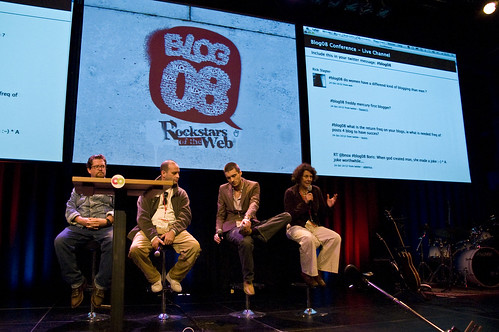
Bloggers Hugh McLeod, Loren Feldman, Pete Cashmore and Elisabeth Winkler get up on stage to answer questions from the floor and the live backchannel at Twitter.

BLOG08

Rick Slagter asks the first question: ‘is blogging is the rescue of slow journalism?’

Loren Feldman is very explicit when comparing bloggers to journalists: “Bloggers aren’t journalists. You’re just a bunch of guys sitting in your livingroom, writing things.”

Pete Cashmore comes to the defence of bloggers and jokes that “sometimes we dress up and we wear pyjamas.” He describes the current media landscape as an eco-system where bloggers and journalists complement each other.

Winkler sees the overlap between journalism and blogging in the connections between opinion and fact. However, a fact needs a context because everyone has an agenda, and the major media aren’t very clear about their agenda. She sees blogging as a little more transparent.

Cashmore compares the discussion to the endless discussion that is still going on surrounding the term ‘web 2.0′. We spend a lot of time and posts on trying to define it, which leads to endless discussion, he says. The whole journalism versus bloggers debate depends on how you define journalism.

Paul Bradshaw from the Online Journalism Blog enters the debate with his opinion that ‘is blogging journalism?’ is an old question and that we need more challenging ones.

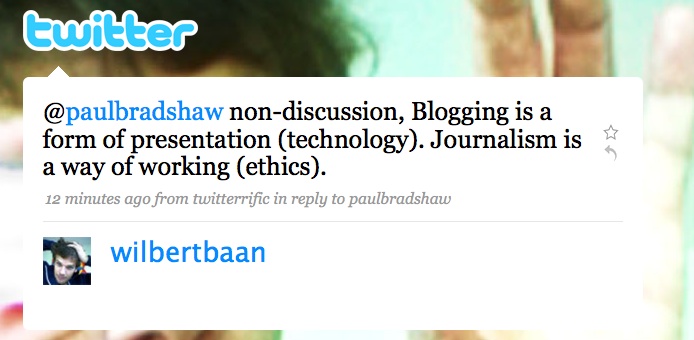
The best part of the discussion seems to be happening on Twitter, where Wilbert Baan (Interaction Designer of the Volkskrant newspaper website) replies to Paul Bradshaw’s statement with this insightful comment:

And me? I think the distinction between the medium and practice of blogging is an important one, especially in relation to journalism.

This post originally appeared on Anne Helmond’s blog.

Tags: , , , , , , , , , , , , , , ,

Similar posts:

Blog08: Journalism versus hearth blogging

October 24th, 2008 | 1 Comment | Posted by in Events, Online Journalism

Not your average panel with Tim Overdiek, deputy editor in chief at NOS news; Clo Willaerts, marketing manager for Sanoma Magazines Belgium; Paul Bradshaw from the Online Journalism Blog; and Piet Bakker, professor at the Hogeschool Utrecht.

The journalism/blogging panel aims to answer questions gathered via de Nieuwe Reporter, one of the largest Dutch journalism blogs.

Tim Overdiek from NOS News shares that over a hundred NOS colleagues from a total of 400 have contributed to weblogs.nos.nl. Only forty employees are active bloggers but a hundred contributions in the form of either comments or blog posts is a certainly good number.

He remarks that professional journalists often don’t see bloggers as collaborators but as a form of contribution, as something they can use. There is no direct participation. The participating journalism that Dan Gillmor refers to is not happening in the Netherlands, according to Overdiek.

We’re currently moving beyond blogs, and the practice of blogging has gone beyond the medium of the blog and has partly and moved to Twitter for example. There is a whole world to gain for bloggers and also for organisations to actively set out to get people blogging.

It is interesting to note that during one of the previous sessions Tim Overdiek sent out a tweet to remind himself to create a 101 Teletekst Twitterfeed asap.
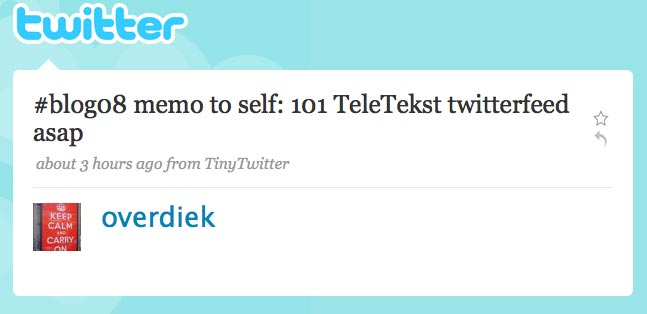
Teletekst is the Dutch equivalent of the BBC Ceefax and the 101 page is the standard page for news headlines. It is interesting to see how one of the most popular ways to keep up with the news is going to be syndicated on Twitter in the near future. The NOS is focusing on embracing the new social media and sees syndicating existing content on different platforms as the next step.

The question that was selected from the Nieuwe Reporter was a rather odd choice since there was a lot of discussion about the relevance and phrasing of the question in the comments (in Dutch). Unfortunately the question also eventually drived the discussion nowhere:

Imagine there would be a stock exchange for newspapers, broadcasters, magazines, weblogs, and other media. Which stocks would you buy when taking the next five years in account?

Tim Overdiek: Buy stocks in NOS, we have great outlets, we have different platforms such as mobile TV, blogging and Twitter. The NOS media department is pretty tech savvy. However, he advises not to bet on just one company because there are too many interesting things going on in different places.

Piet Bakker would buy stocks in magazines because the problem with blogging and internet is that to monetize it is quite difficult.

Paul Bradshaw would also buy stocks in magazines because all of the advertising on the internet pretty much goes to Google. Offline and online advertising are not on the same level yet and on top of that magazines have a lot of muscle. Bradshaw thinks that they will buy out successful blogs. Newspapers are also trying to be more like magazines which shows the bright future of magazines but they don’t see it quite yet.

Journalists should work with bloggers on a level playing field. He [Bradshaw] mentions the example of a newspaper that recently recruited 40 bloggers but it’s not a top down relationship with one main editor that makes all the decisions. He sees this as a good way forward because journalists and bloggers should treat each other like citizens.

This post originally appeared on Anne Helmond’s blog.
Tags: , , , , , , , , , , , , , , , , , , , , , , , , , ,

Similar posts:

© Mousetrap Media Ltd. Theme: modified version of Statement