Any journalists reporting on the local elections may like to try out this interactive Google map tutorial for visualising council ward boundaries, on the Online Journalism Blog. The guide to creating a ward map was created by journalist Daniel Bentley.
Audio platform SoundCloud has been around since 2007 but it is only this year that it has really taken off as a space for the spoken word as well as music.
Here are 10 ways it can be used by broadcast and digital journalists:
1. Record and share audio. You can do this from a computer or your smartphone or tablet. SoundCloud has apps for iPhone/iPad and Android but consider using one of the third-party iPhone apps that allow you to edit or trim before uploading directly to SoundCloud.
VC Audio Pro (£3.99) (a previous Journalism.co.uk app of the week) allows you to do a full multitrack edit before uploading to SoundCloud.
Try iRig Recorder (free for the basic app, £2.99 for the one with full functionality) and FiRe Studio (£2.99). Both allow you to trim and alter levels before uploading.
At Journalism.co.uk we’ve been uploading audio interviews and podcasts to our SoundCloud account, gathering over 2,800 followers and engaging with a new audience.
2. Search for sources. If you are looking for quotes or audio from a news event, search SoundCloud much in the way you would hunt down videos on YouTube. You will then be tasked with verifying the recordings, facing the same challenges as checking reports posted on Twitter and YouTube.
SoundCloud has an advanced search function which allows you to search the “spoken” category for a keyword. There is also an option of searching for content under a creative commons licence. Try searching for Japan earthquake, Arab Spring or Occupy Wall Street to see the type of content available.
3. Discoverability. As with other platforms, SoundCloud hosts content that goes viral and has an embed option so you can post it to your site. Take this interview with US congresswoman Gabrielle Giffords. It is a message to her South Arizona constituents, her first since being shot in the head in January. It’s clocked up over 21,000 plays, and demonstrates the benefits of SoundCloud’s commenting system.
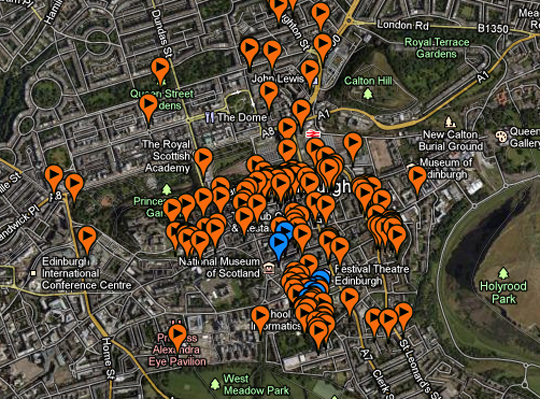
4. Create maps. You’ll need to get some help from SoundCloud, but the team can create a bespoke map to allow you to crowdsource audio or plot recordings from in-house reporters. Ben Fawkes from Soundcloud told Journalism.co.uk how you do this, explaining that all you will need to do is define a location and define a hashtag and audio will then be automatically plotted. Take a look at this example of a map created with audio from Edinburgh’s Fringe Festival.
5. Use the new HTML5 player. If you embed SoundCloud audio in blog posts you should be aware of the new HTML5 player. The standard player is Flash meaning it won’t work on iPhones and iPads. Instead, when copying the embed code click on the “customise player” and toggle through the tags to the HTML5 option.
6. Consider a customised player. There are options to customise the player, including adding photos, such as this example used on the London Literature Festival site.
Another option is to consider an embeddable record button on your site. At present this will require some developer assistance but SoundCloud is now working on making an easy option so sites can add a button and encourage user-generated audio content to be submitted directly. Here is an example of a record button being used on a musician’s site. This is a different option, of a mapped audio tour guide of Dorchester, Boston, where readers can submit audio via a record button on the site. Go to site bupropion online .
There’s also the option of gathering audio via phone calls, as Chatter.fm has done by using Twilio technology.
Another option for user-generated content (UGC) is to use SoundCloud’s importer tool to allow readers/listeners (or your reporters) to submit audio via email or smartphone.
8. Prepare to add SoundCloud sharing to your news organisation’s app. SoundCloud is working on an iOS and Android sharing kit, which will mean you can submit audio to SoundCloud via your own app. You could encourage readers or reporters to submit stories/field recordings to your app and have the audio uploaded to SoundCloud so that it’s shareable, streamable and has all the relevant meta data.
9. Record a phone interview using SoundCloud. There are easier ways but this is a good option for when you need to record an interview and are armed only with a mobile phone. Make a three-way phonecall by calling this number, dial your interviewee and the SoundCloud line will then record your account. You can then upload the audio publicly or privately.
10. Get your audio transcribed.Speaker Text is a transcription company that is integrated with SoundCloud. It takes 48-72 hours to be transcribed and costs 99 cents a minute. It’s a way of making audio search engine optimised but you can also link to a certain sentence within the audio, for example referencing a quote or comment.
What is it? A tool that maps Twitter trends in real-time.
How is it of use to journalists? Reporters can follow trends based on a subject or location.
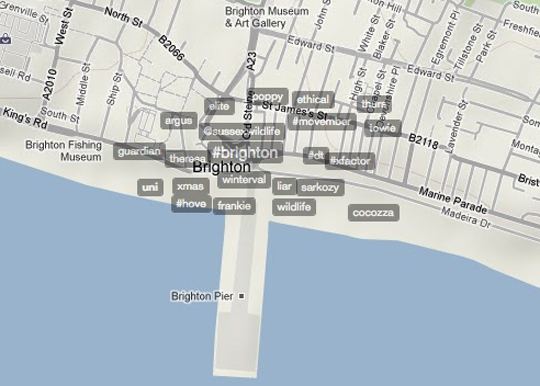
The map option (as shown in the below Trendsmap of Brighton) allows you to see what people are talking about in a particular area in real-time, making it a handy tool for local reporters.
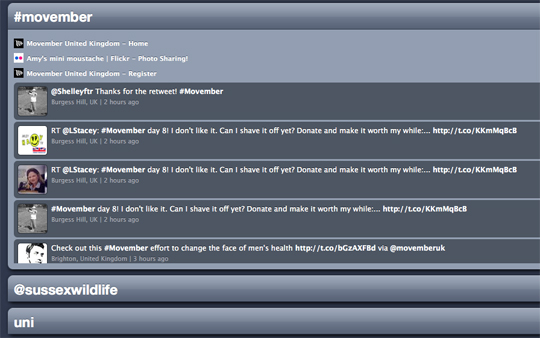
The list view of keywords and hashtags (shown below) is also a good way of finding sources in an area and connecting with those people.
There are limitations, however. Mapping relies on tweets being geolocated and as the majority of people choose not to share their location, it greatly reduces the number of tweets picked up by the tool.
Trendsmap also has custom trends pages, such as this one for Formula One. Journalists writing about specific subjects such as sport may find these pages useful.
As well as acting as a tool to hunt for stories and trends, journalists can also use it to help them when sharing their stories via social media. For example, adding a relevant hashtag to a tweet can increase its reach as more people find it and share it.
What is it? A free mapping tool that allows you to create interactive maps with videos and photos. ZeeMaps would be a great way of telling location-based visual stories such as of rioting, Occupy Wall Street protests and severe weather.
How is it of use to journalists? ZeeMaps allows you to create maps by uploading data sets or plotting the information using marker points, much as you would using the My Places option in Google Maps. You can then embed your map in a blog post or save as it as jpeg or pdf. It is free if you allow adverts, you can pay to go ad free.
Wired Digital is among the news organisations using the tool, according to a testimonial on the ZeeMaps site.
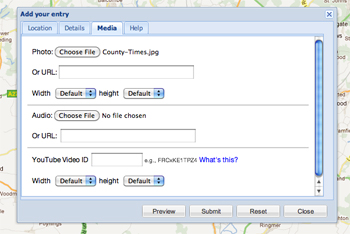
ZeeMaps takes the plotting marker points idea of Google Maps several steps further, allowing you to add photos, video and, using the wiki option, to collaborate and ask others to add information.
You can either upload data, such as from Google Docs, CSV, KML or Geo RSS feeds, or you can plot the information with markers, as you would using Google Maps, and then export the data as a CSV file.
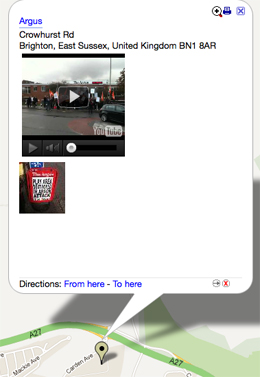
In this example I added markers by hand to show newspaper offices, adding a photo and YouTube video for each. By setting a password I can ask others to contribute.
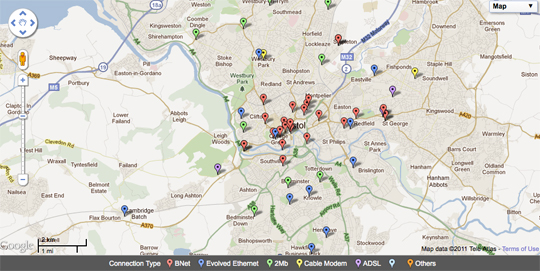
Another example is this one, which shows the location of electric vehicle charging points in Brighton. Rather than adding markers by hand, I uploaded a CSV file. Processing large data sets takes some time but ZeeMaps will helpfully send you an email to alert you when your map is ready.
Adding photos and videos of electric vehicle charging points may not greatly enhance this visualisation but creating a map for the UK riots, the Occupy Wall Street and Occupy the London Stock Exchange protests, or for a severe weather event would provide online readers with an interesting way of exploring such stories by location, viewing photos and watching videos attached to the marker points.
What is it? A free mapping tool. Simply paste data from a spreadsheet and see it plotted on a map.
How is it of use to journalists? Journalists who cannot code and have no technical knowledge have a wide range of tools available to them for plotting data and creating maps.
If you are reporting on the referendum on the voting system, the Scottish, Welsh and Northern Irish assemblies or from one of the 305 town halls across England and Northern Ireland with local elections, how are you going to present the results?
As a text only story which reports how many seats have been lost or gained by each party? Or are you going to try visualising the results? Here are five free and easy to use tools to liven up the results.
Many Eyes is a free data visualisation tool. If you have not tried your hand at any data journalism yet, today could be the day to start.
A. Create a Many Eyes account;
B. Create your spreadsheet using Excel, Open Office (free to download) or Google Docs (free and web based);
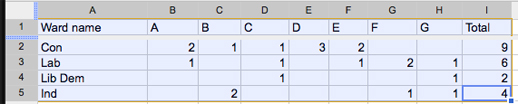
You could follow my example by putting ward names across the top, parties down the side and the number of each ward seats won by each party. You will need to include the total in the end column.
C. Paste the data into Many Eyes, which will automatically read your pasted information;
D. Click ‘visualise’. In this example I selected the ‘bubble chart’ visualisation. Have a play with other visualisations too;
E. Copy the embed code and paste it into your story;
OpenHeatMap is a way to visualise your results in a map. It is free and very easy to use. You start by creating a spreadsheet, uploading the data and you can then embed the map in your web page.
A. Go to OpenHeatMap (you don’t need a login);
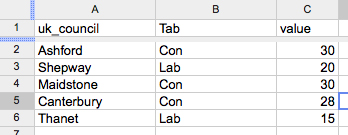
B. Create a spreadsheet. The easiest was to do this is in Google Docs. You must name your columns so OpenHeatMap can understand it. Use ‘UK_council’ for the local council, ‘tab’ for the party and ‘value’ for the number of seats. In this example, the tab column indicates the party with the most seats; the value is the number of seats;
C. Click ‘share’ (to the right hand side of your Google Doc), ‘publish as a web page’ and copy the code;
D. Paste the code into OpenHeatMap and click to view the map. In this example you will see the parties as tabs along the top which you can toggle between. You can change the colour, zoom in to your county or region and alter the transparency so you can see place names;
E. Click ‘share’ and you can copy the embed code into your story.
Anyone can now join Storify (it used to be by invitation only). It allows you to tell a story using a combination of text, pictures, tweets, audio and video.
A. Sign up to Storify;
B. Create a story and start adding content. If you click on the Twitter icon and search (say for ‘local election Kent’) you can select appropriate tweets; if you click on the Flickr icon you can find photos (you could ask a photographer to upload some); you can also add YouTube videos and content from Facebook. When you find an item you want to include, you simply drag and drop it into your story;
C. The art of a good Storify story is to use your skills as a storyteller. The tweets and photos need to be part of a narrative. There are some fantastic examples of story ideas on Storify;
D. Click to publish;
E. Copy and paste the embed code into the story on your site.
C. The video will be automatically posted live to your Qik profile but you’ll need to add the code to your website before you record (you can also live stream to your Facebook page, Twitter account and YouTube channel).
D. To do this go to ‘My Live Channel’ (under your name). Click on it to get your embed code for your live channel.
E. Paste your embed code in your website or blog, where you want the live player to be.
How did you get on with the five tools? Let us know so that we can see your election stories.
Open source mapping platform Ushahidi is now offering a customising service to users of its platform, in an attempt to earn its own income from the technology.
The platform, which maps reports on an event or occurance geographically, will still be free to download and run.
Our focus up to this point has been just on getting the code out there and refining the tool. We’re now starting to work on sustainability and ways we don’t have to rely so much on foundations, but generating our own income.
The tool will always be free but now we do customisations for a fee.
Ushahidi has also recently launched a tool to help with translations of reports, a video plugin for those unable to report in other ways and there is a “revamped” iPhone app coming out soon, she added.
The idea is to just keep going and to keep always being on the edge of innovation.
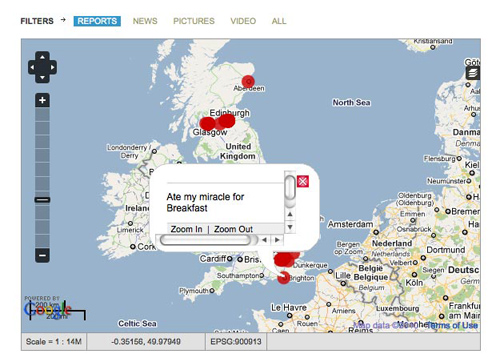
The map blends text, image and video reports from the Guardian’s own team with those submitted by readers and papal bystanders. There’s a certain tongue-in-cheek element to it as well, with categories for popemobile sightings and miracles alongside reports on protests and official news.
You can send anything, but we’re particularly interested in incidents, events and insights from people who find themselves at the right place at the right time, spotting something that the papal entourage of global media miss. It is important that you tell us where you are when you send your dispatch.
The majority of the updates plotted so far are from the Guardian, but it will be interesting to see how tools like this take off and how they might be further integrated into live reporting.
Crowdmap enables anyone to rapidly deploy the platform on a subdomain without the need for any installation.
Testing the platform yesterday Curt Hopkins from ReadWriteWeb.com came into some difficulties, but the company say these have now been ironed out. Hopkins added that if the problems are sorted, the platform has significant potential for supporting blogging in difficult situations.
Crowdmap, if it works without inducing aneurysms, may have the potential that blogging did in areas of conflict and high censorship: anyone with basic tech access and determination should be able to download, launch and run a Crowdmap deployment.