Browse > Home / Archive by category 'Online Journalism'

| Subscribe via EMAIL | Or RSS

What does PCC Iain Dale ruling bode for Jan Moir case?

November 6th, 2009 | No Comments | Posted by Judith Townend in Newspapers, Online Journalism

As noted a short while ago, the Press Complaints Commission ruled that it had found a Daily Mail diary piece about potential Conservative candidate Iain Dale not to be in breach of the PCC code. “I still think it was a clear breach of Section 12 [discrimination] of the PCC code.  I quite agree with what they say about the right to offend, but this was gratuitous and it was the second time it had happened,” Iain Dale told Journalism.co.uk.

“I have no idea if it affected my chances in Bracknell [constituency where Dale was competing for the Conservative candidacy], but it certainly wouldn’t have helped. It seems clear to me now that the PCC will reach the same judgment in the Jan Moir case.”

Meanwhile, Guardian blogger Roy Greenslade, who agrees with the PCC ruling on this occasion, ‘imagine[s] that the commission will take the same view about Jan Moir’s column, which was far more offensive than Ephraim’s remarks about Dale’.

Tags: , , ,

Similar posts:

Comment: The problem with PR email

November 6th, 2009 | 5 Comments | Posted by Iain Fleming in Online Journalism, comment

As Journalism.co.uk reported earlier this year, former PR Manager and national newspaper journalist Iain Fleming decided to try and assess which PR distribution methods work and which don’t, by conducting a small survey as part of his CIPR (Chatered Institute of Public Relations Diploma) course at Queen Margaret University. He now works as the business development manager for Wirefast, which provides the Newslink story and picture wire service and is launching a new multimedia management, distribution and syndication service, called Tradeclips, on 19 November.

As the PR industry has grown – from being worth just over £106 million in 1986 to £6.5 billion in 2005 – so has the number of people working in it and inevitably producing material to send to the media. Back in 1985 fax machines were just coming in and were expensive to buy and run, and most material was still sent by post, so there was a direct financial link to distribution.

Jump forward 20 years and there has been a huge increase in media outlets. So most people in PR have to use some form of directory. If it costs an agency several thousand pounds per year to access an online database, but they are allowed to email as many addresses as they like free of charge through that database, then it is no wonder that content is literally being sprayed in a scattergun approach by many.

Now add in to the mix the growing adoption by publishers and broadcasters of websites linked to their traditional products and the need to use multimedia content, but source it for as little as possible – preferably for free from readers and viewers/listeners – and we now have a situation where an industry is rapidly shedding staff but expecting those who are left to take on more work and learn new techniques.

So it came as no surprise to me that the results of my small survey – including responses from 101 editors, section editors, journalists and IT managers – showed just how much those working on news desks disliked the PR industry – despite their growing reliance on it. So much of what is being thrown at them is completely irrelevant – if it gets to them at all.

What does get through – and 95 per cent reported problems with email of which around a quarter said it was ‘every day’ – is sent in ways which either crash their systems or can’t be opened because their employers simply cannot afford to upgrade software on 200 computers as regularly as a small PR agency of just a few people can – and does.

And that is just for ‘traditional’ text and pictures. The message that a national newspaper can happily use a picture – even across several columns – if it is only a few hundred Kb in size has not got through to the PR people, who keep sending out 10Mb files at a time.

Move on to ‘new’ media and the situation is even worse, with the same issues of incompatible file types, too large files, poor quality content and stuff that is ‘just not newsworthy’ topping the list of complaints. A senior manager within ITV told me just last week how one station struggled for several hours to get video sent by a fire brigade into a format suitable for broadcast, but ran out of time and the bulletin went out minus the footage.

This isn’t a rant about email – I don’t know how we managed to exist before it came along and I was an early adopter, although I can’t now remember my first Telecom Gold address back from 1984. It is ubiquitous and for many – probably most – people working in PR – it is all they know and is an appropriate method. It is a system which has mushroomed and in the space of five years moved from being a ‘nerdy’ plaything to universal acceptance and usage.

But there are many PR practitioners who don’t know of anything else but really should, for every day they are flying by the seat of their pants and taking an unnecessary risk, potentially with the lives of many others. They are the people working under civil contingencies legislation and have a responsibility to ‘warn and inform’ the public – they work for the ‘blue light’ services, the NHS, local authorities and the like. They are supposed to use what the legislation says is a ‘robust’ form of communication, and by no stretch of the imagination is e-mail ‘robust’.

The governments in both Westminster and Holyrood have been investing millions recently in new and secure networks and providing things like satellite phones to such organisations, and while their internal communications may be ’secure and guaranteed’, these networks don’t  – and never will – extend to the media. There are ‘robust’ services out there – of which my employer Newslink is but one – but the basic understanding of effective communication methods beyond email, mobile phones and fax by even the most senior PR practitioners is simply not there.

I met the head of comms of a major public utility – in the news that day for an issue potentially affecting the health of hundreds of thousands of his customers – at an event in London earlier this month, and tried to discuss the issue with him. The best he could come up with was that ‘he was sure’ they used methods other than email, but could not tell me what they were, nor could he see the importance of being able to guarantee delivering messages affecting public safety. We are on the cusp of a possible swine or bird flu pandemic, but for all of the planning which has been done, how much of it assumes that warning messages will actually be able to be delivered?

I know and appreciate that media distribution is the ‘back end’ of a very creative process – but what is the point of writing the best press release in the world if it never gets there?

So I believe my project has some merit, and may be of value to others. I don’t claim it to be anything other than it is, a university project to which just over 100 editors and journalists contributed and by its very nature could be seen as partial, but I believe it does reflect what is happening in the industry just now.

Findings from Iain Fleming’s research:

  • Lack of targeting, sending large attachments – often in formats which the recipient cannot access – and making ‘follow-up’ calls were just some of the main complaints by the 101 editors, section editors, journalists and IT Managers who responded to the survey.
  • The project also reveals that the practice of making ‘follow-up’ calls by PR practitioners is intensely annoying and ultimately counter-productive, while the demands made on news desk staff by media distribution companies updating their databases are also heavily criticised by journalists.
  • While the media is encouraging user generated content from readers and viewers, much of the content – like that supplied by PR professionals – is unusable because it is sent in the wrong format, is technically unsuitable or is ’simply not newsworthy’.
  • The research highlights that many public sector organisations with responsibilities under civil contingencies legislation to ‘warn and inform’ the public are relying on a communication method which is not ‘robust’ and not guaranteed to work in an emergency.
  • Due to the unreliability of email, a lot of material never gets there, and if it does, it can’t be opened. And if it can be opened, much of it is irrelevant and just wastes the time of the recipient.  Fifty-five per cent of respondents said that less than ten per cent of the material sent to them from the commercial sector was relevant and 83 per cent said they wanted less material. Only 10 per cent of respondents said they wanted more content from commercial PR operators.
  • While content from the public and non-commercial sectors (local authorities, NHS, charities etc) fared somewhat better, with 25 per cent saying they wanted more from such contributors, and 54 per cent saying they wanted less, this still indicates that a great deal of time and effort is going to waste.
  • The survey looked at the way such material is now delivered, and showed that 80 per cent is sent by e-mail and fax represents less than five per cent.
  • While email has become the dominant distribution method, the survey showed that almost 95 per cent of respondents had suffered problems with it, and almost one quarter reported this to be every day, with half reporting problems several times a week or weekly. This included delayed delivery or even outright failure of messages to arrive, corrupt characters or badly-formatted content, multiple copies and spam.

Tags: , , ,

Similar posts:

What’s Murdoch’s ‘cool new toy’ for accessing media content?

Australian media is busy speculating over Rupert Murdoch’s new idea for content access.

Margaret Simons of the Content Makers, reports how Caroline Overington, senior writer and columnist with The Australian (part of Murdoch’s News Limited) let slip that Rupert Murdoch’s pay wall plans might include a ‘cool new toy’ for accessing media content.

Simons reports from the Media140 conference:

“Overington said that News Limited had many wonderful plans of which they were very proud, and they could not be unveiled yet, but she believed they would lead people to pay for content.

“Then in the closing stages of the session, she referred to iTunes, and how people had turned to paying for music that they could get elsewhere for free because of the entry of a ‘cool new toy’ in the iPhone.

“She added: ‘That’s kind of what we are thinking about.’

“So what is it, I wonder? Some kind of deal with Apple, soon to release its new electronic reader? A competing product? Very intriguing.”

An update, pointing to coverage of the Apple Tablet negotiations, with more speculation on the ‘iRupert’ at this link.

And Overington at Media140 courtesy of SlowTV.

Tags: , , , , ,

Similar posts:

#FollowJourn: @NigelBarlow/media blogger

#FollowJourn: Nigel Barlow

Who? Recently completed a journalism degree at UCLAN; works for Innovation Manchester; seeking journalistic opportunities.

What? Relevant, speedy and succinct comment on his personal blog that focuses on media and digital developments.

Where? @nigelbarlow/http://thoughtsofnigel.blogspot.com/

Contact? On Twitter or nigelbarlow22 [at] gmail.com

Just as we like to supply you with fresh and innovative tips every day, we’re recommending journalists to follow online too. They might be from any sector of the industry: please send suggestions (you can nominate yourself) to judith or laura at journalism.co.uk; or to @journalismnews.

Tags: ,

Similar posts:

Jon Hickman: Why has the Guardian received little backlash over jobs board hack?

November 6th, 2009 | No Comments | Posted by Judith Townend in Editors' pick, Jobs, Online Journalism

Cast your minds back a few weeks: the Guardian UK jobs board, operated by Madgex, was targeted by hackers. The Guardian reported the incident in its print edition, and the comments beneath an initial blog post show some strong criticism and speculation over why the attack occurred.

But Birmingham City University researcher Jon Hickman reflects that it passed with ‘little comment’:

“Guardian Jobs must have many thousands of members, and this security breach could be affecting them all in a very real way, yet I haven’t seen much in the way of a backlash.

“Twitter should be out in force decrying this failure in the website’s duty of care. Questions should be asked of the Guardian’s response which puts the onus on individual consumers. Instead: nothing.

“How, in these times of consumer activism and online protest has this passed uncommented? Given the pressures of the marketplace, why do The Guardian not have to work hard to keep in favour with their audience?

“Perhaps even in this digital age the old myths of the mainstream news media still hold true today: we work for them, all the while thinking we are the customer when in fact we’re the product.”

Full post at this link…

(via @PaulBradshaw on Twitter)

Tags: , ,

Similar posts:

Huffington Post: Early signs of success for citizen journalism investigation

November 6th, 2009 | No Comments | Posted by Judith Townend in Editors' pick, Online Journalism

The Huffington Post claims that one of its first investigative projects shows evidence of a ‘new alliance between professional reporters and citizens who have a high interest or expertise in a particular topic’:

“Several weeks ago, as one of our first investigative projects, we set out to explore how insurance companies decide which claims to approve or deny. Regulators, lawmakers and policy makers seem to be in the dark about that important aspect of the health care system, since insurance companies generally are not required to disclose their rules, methods or records about claims. Investigative Fund reporter Danielle Ivory wrote about this lack of available data and invited citizen journalists to help us investigate. Hundreds of people volunteered. And they’ve already helped us extend and deepen our journalism. Many have volunteered personal tales about their dealings with insurers. Others are health professionals and insurance insiders with direct experience in the claims process.”

Full post at this link…

Tags: , ,

Similar posts:

Testing times for Mail Online’s comment system

The introduction of a rating system for comments on articles on the Daily Mail’s website back in December last year was a bold move for a site that often publishes highly controversial (or certainly comment-provoking) articles.

Comments on the site can be removed by the editorial team if necessary, but the aim of the system is that users will act as moderators, flagging up inappropriate content.

One particular story last weekend tested its mettle: the report on the death of a man in the back of a lorry in the channel tunnel.

The article in question provoked a spate of offensive and abusive comments (as shown in this screengrab captured by FiveChineseCrackers.com).

As Mail Watch points out in a post on the matter: “If these are the highest rated, and thus most visible, comments, how does that reflect upon the ‘controls’ and ‘processes’ used by Mail Online to prevent ‘inappropriate content’ appearing?”

By Monday afternoon the comments referred to had been removed from the piece. At time of writing this blog post, only two comments appeared on the article and additional comments are no longer being accepted:

Mail Online comments on migrant death article

As Mail Online’s terms and conditions page states, the site is not liable for third party content including comments posted by users.

And the site’s own House Rules suggest that pre-moderation of comments is not always the case:

“Reader comments that violate the letter or spirit of these rules or our Terms may be removed (or, if checked in advance, not published in the first place). If we do remove something, we will generally remove whole posts, or where necessary, whole threads (not parts). This means that even if only one sentence is objectionable, the whole comment will usually be removed (or not published).”

In this case, however, the screengrab clearly states above the offensive comments: “The comments below have been moderated in advance.”

Asking how such incidents affect the Mail’s attitude to commenting, a spokesman told Journalism.co.uk:

“As regards the Channel Tunnel story, several inappropriate comments were posted until they were rightly flagged up through the ‘report abuse’ facility when we immediately took them down. This shows our system is working as it was designed.

“The comments facility is a much-loved part of Mail Online and phenomenally popular.

“To enable as many people as possible to have their say the vast majority of our comments are now not moderated in advance. This presents a new challenge for us and our readers but we are happy the system is working well.”

Tags: ,

Similar posts:

Brighton Argus recruiting police community bloggers; PCSO Sam Justice among them

It’s nearly an entry for the Radio 4 ‘Sorry I Haven’t A Clue’  Late Arrivals game, and definitely a candidate for PopBitch’s ‘Favourite’ feature: PCSO Sam Justice is among the new police community support officer bloggers recruited by the Brighton Argus.

As reported very speedily by Sarah Hartley this morning, Newsquest’s Brighton Argus plans to use community police officers to cover local beats for its hyperlocal network.

“I’m hoping the contributions to the site will start becoming really varied, a mixture of people hoping to cut their journalistic teeth, the community figures who have always reported on their neighbourhoods in some shape or form, and those who want somewhere to get their voices and stories heard,” web editor Jo Wadsworth told Journalism.co.uk.

brightonbeachAnd if she’s looking for more contributors, Journalism.co.uk would highly recommend checking out Channel 5’s Brighton Beach Patrol, featuring some wonderful characters we’ve been looking out for ever since [show pictured left].

Wadsworth has been building up the community correspondent network for a while: around six months ago, students from Brighton Journalist Works were brought on board. Students upload weekly vox pop video interviews with members of the public and three students run a weekly fashion blog.

Earlier in the year she recruited – with a little egging-on from Journalism.co.uk – Guardian media blogger Roy Greenslade as a Kemp Town community correspondent, whose latest post can be viewed here.

Tags: , , , , ,

Similar posts:

Revolution: Welt Kompakt launches Google Wave to reach readers

Welt Kompakt, sister title of German national newspaper Die Welt, has created a ‘wave’ on Google’s new service in a move to attract younger readers.

I don’t have an invite so if you can access the wave at this link, tell us what Welt is doing and if it works for you.

Full post at this link…

Tags: , ,

Similar posts:

NYTimes.com: New York Times presents its ‘Innovation Portfolio’

November 5th, 2009 | No Comments | Posted by Laura Oliver in Editors' pick, Multimedia, Online Journalism

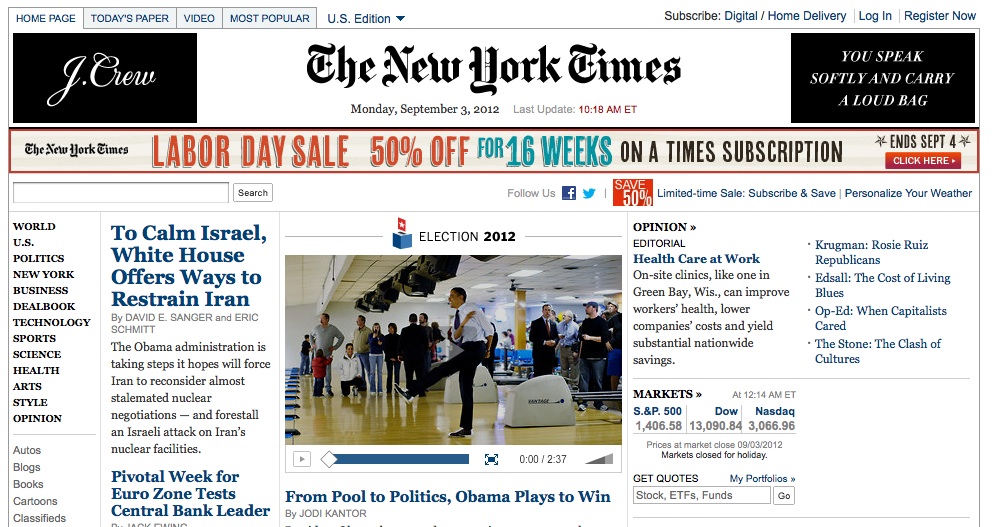
Journalism.co.uk has reported on many of the New York Times’ developments with data journalism, interactive features and graphics. Now the title has group together all its experiments in interactive design and infographics – from multimedia timelines to those submitted by users – in a beautifully designed web portfolio.

New York Times' Innovation Portfolio site

Full portfolio at this link…

Tags:

Similar posts: