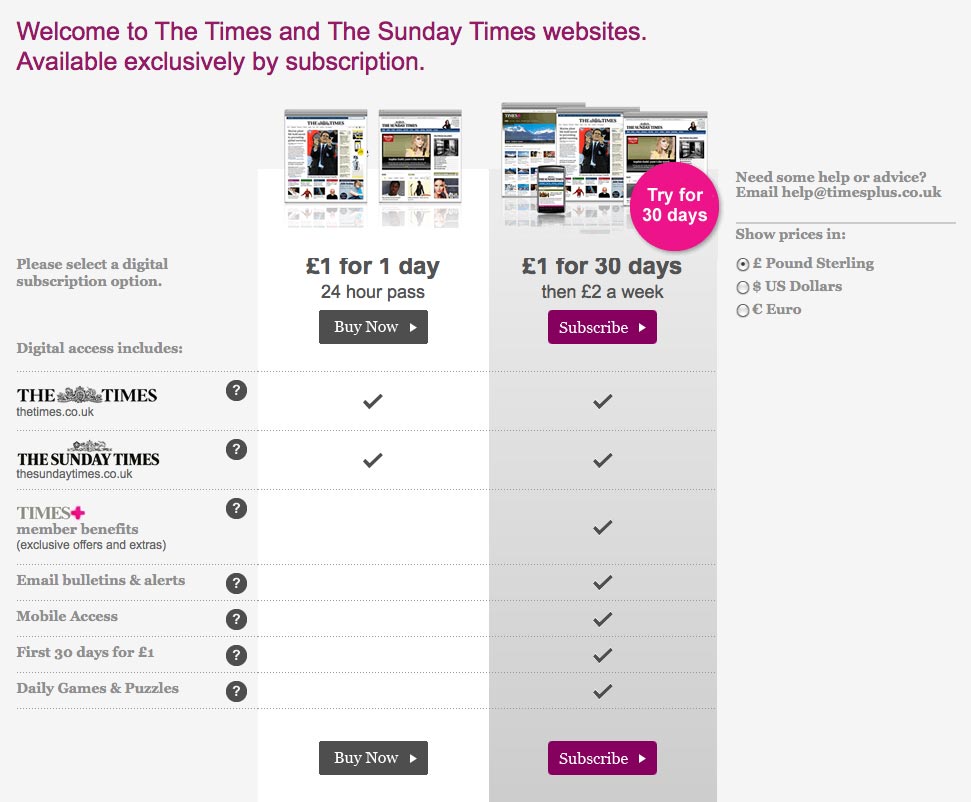
And it’s up – the long awaited News International paywall for the new Times and Sunday Times websites has gone up today. This is the screen you get when you try to go beyond the sites’ homepages – thetimes.co.uk and sundaytimes.co.uk. It’s interesting to see what’s not included in the £1 day pass option: email bulletins, mobile access and daily puzzles.
What the web and world is saying about it:
- ExchangeWire.com asks what impact the paywall will have on CPM (Cost per thousand impressions) rates and where it will drive traffic to;
- Science writer Ed Yong laments the paywall’s effect on science journalism from the Times;
- BBC Breakfast describes the paywayll as “a tollbooth in the middle of the ocean”;
- The Guardian cheekily offers a “warm welcome” to “former Times readers” on its News Blog;
- And The Beta Blog looks at paywalls and “game theory”.
I can’t see what the problem is – Journalists and writers have to be paid and if web advertising revenues are too low (and they are) then money has to come from somewhere. This affectes all print media – I blogged in respect of model making magazines some time ago (http://philsworkbench.blogspot.com/2010/04/is-web-future.html) – web users who don’t pay can be ditched in preference to those who do. Let them go to your competitiors as you’ll push their website costs up whilst handing them no income. The perfect storm in many ways and probably what Rupe is hoping for…
It’s going to happen between now and eternity, but for Pete’s sake can’t you newspapers cooperate at least on something important like this?
Or is this day 1 of a whole week of paywall-risin’?
Still, I’d like to have some paper in my hand once a week, just for waking up lazy. How about a nice weekly opinionated summary in a Sunday paper?
Pingback: links for 2010-07-03 « David Black
I thought the concept of paywalls had more to do with propping up expensive printing and logistics operations than paying for quality journalism.
Pingback: This Week in Review: Time’s non-pay paywall, free vs. pay in Britain and what to do with content farms » Nieman Journalism Lab
Pingback: This Week in Review: Time’s non-pay paywall, free vs. pay in Britain and what to do with content farms | This Is An Awesome Web Site
Pingback: David Mitchell breaks ranks to question Guardian paywall stance | Journalism.co.uk Editors' Blog
Pingback: This Week in Review: Time’s non-pay paywall, free vs. pay in Britain and what to do with content farms | This Is An Awesome Web Site
Pingback: This Week in Review: Time’s non-pay paywall, free vs. pay in Britain and what to do with content farms | Mark Coddington