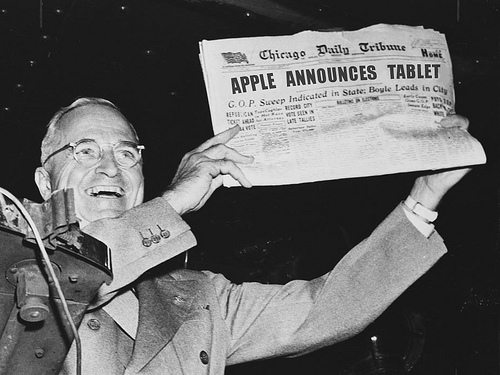
The hype surrounding Apple’s new touch-screen mini-computer, predictably, is huge. Just like film studios, book and textbook publishers, news producers are hoping the iPad can boost the online, mobile content marketplace.
Here’s a “source”, who purports to have worked with Apple CEO Steve Jobs, telling the Wall Street Journal exactly what it wants to hear:
Mr. Jobs is “supportive of the old guard, and [he] looks to help them by giving them new forms of distribution”.
One publishing CEO was even moved to write poetry about it (via Moconews.net) and Apple fanboys and news executives will no doubt be glued to their screens when Jobs takes the stage at around 6pm (GMT) tonight to announce the details.
But when the hype dies down, will the journalism business really be in better shape? These people have taken a welcome dose of reality juice:
- Craig McGill, a former journalist now plying his trade at digital PR firm Contentlymanaged, quite reasonably asks who is going to create all the content for new organisations’ multiplatform mobile packages given all the job cuts in news publishing in the past year.
- Forrester analysts Charles Golvin and James McQuivey consider that maybe the iPad won’t be all it’s cracked up to be: “It is flawed in meaningful ways: It’s a computer without a keyboard, it’s a digital reader with poor battery life and a high price tag, and it’s a portable media player that can’t fit in a pocket.” (via paidContent.org)
- I couldn’t put it better than David Campbell, a professor of cultural and political geography, did this morning: “Information and distribution are separate. Journalism is information, tablet distribution. Can help journalism circulate but can’t ‘save’ it.”
Much is made of iTunes and its successful monetisation of mobile applications and music – the Financial Times is even planning to imitate (via PCUK) its “pay-per-view” micropayments model, although FT.com told Journalism.co.uk last week that paid-for day passes would come first.
The model is attractive: there are more than 100 million iTunes accounts with users’ credit cards pre-loaded and ready to go. A new shiny, powerful device – somewhere between an e-reader and a netbook – could just persuade people to buy the news subscriptions the New York Times and Rupert Murdoch so desperately want to sell them.
But Apple’s new device is just another distribution platform for words, pictures, videos and data, just like PCs, mobiles and print. Recreating a print experience on another device is not going to solve the economic crisis news finds itself in: Google will still be more efficient at selling advertising and will still point readers to free content.
The future of news is about distributing content as widely as possible and monetising not just content but relationships. Devices will be a big part of that, but they’re not the answer.
Photo credit: Mike McCaffery, from Flickr, via a Creative Commons licence.
UPDATE: This post was amended to reflect the announcement of the name of the device, iPad.
Patrick Smith is a freelance journalist and event organiser, and formerly a correspondent for paidContent:UK and Press Gazette. He blogs at psmithjournalist.com and is @psmith on twitter.
![Reblog this post [with Zemanta]](https://img.zemanta.com/reblog_e.png?x-id=59ce27b8-13a6-43ae-b691-89cbf8a3bfb8)
Thanks for the mention Patrick. I would like to acknowledge @RichardStacy as the original source for the importance of the distinction between information and distribution, as linked to in my first post last September on the ‘death of newspapers’ (see http://www.david-campbell.org/2009/09/14/revolutions-in-the-media-economy-1/)
Pingback: The interface with technology — Drawnalism - Digital news drawing
Pingback: Media tradicionais: pela tecnologia (quase) morreram, por ela têm esperança de renascer | Somos Revivalistas vindos do Futuro.
Pingback: Favoriter på nätet – January 28, 2010
Pingback: This Week in Review: What the iPad might do for news, a leaky New York Times paywall, and the Newsday 35 » Nieman Journalism Lab
Pingback: Why the IPad is no secret weapon that will save print – Marc Reeves
Pingback: Favoriter på nätet – February 6, 2010
Pingback: psmith, journalist › Terrorists, iPads, apps and paywalls
Pingback: iPhone app functionality review: price, social sharing tools and adverts in focus | Journalism.co.uk Editors' Blog
Pingback: psmith, journalist › B2B publishers make money from paywalls; can consumer media do the same?
Pingback: psmith, journalist › Is News Over? City University journalism chief George Brock says journalists should accept changed world
Pingback: RSS feeds beat any branded iPhone or iPad news app | Journalism.co.uk Editors' Blog
Pingback: The net & Journalism:Ipad 2 « Louise1243's Blog
Pingback: 10 Quotes on the Apple iPad and the Business of News | Adam Sherk