Browse > Home /

#Tip: Videonotes can streamline online research

April 18th, 2013 | No Comments | Posted by in Top tips for journalists

Keeping track of notes when researching a story can sometimes be a struggle, especially when they refer to online resources. Videonotes (not to be confused with VideoNote) can help to ease the process by letting you tag notes to any video from around the internet, as this article from The Next Web explains.

If you have a tip you would like to submit to us at Journalism.co.uk email us using this link.

Tags: , , , , , , ,

Similar posts:

#Podcast – What journalists should know about App.net

App.net is a Twitter-like microblogging service and open platform which launched earlier this month.

Users pay $50 a year to be members and in return they get the guarantee that the platform will always be open and it will never have advertising.

You can read more about what it could mean for journalists and news outlets in our Q&A with founder and chief executive of App.net Dalton Caldwell.

In this podcast Journalism.co.uk technology editor Sarah Marshall looks at what journalists should know about App.net.

The podcast hears from:

You can hear future podcasts by signing up to the Journalism.co.uk iTunes podcast feed.


Tags: , , , , , , , ,

Similar posts:

#Tip of the day from Journalism.co.uk – a browser extension for marking your reading point

February 23rd, 2012 | No Comments | Posted by in Top tips for journalists

The Next Web has pointed out a handy Chrome extension called youRhere.

It allows you to “not only save the things you’d like to check out or share later, but it will let you save the exact spot where you left off while reading it”.

Whether you get pulled into a meeting or have to walk the dogs, you’ve probably started to read an article and had to drop everything that you’re doing. Rather than have to re-read what you’ve already read later, you can double click a line in the article and youRhere will remember it for you.

It is worth taking a look at our 10 incredibly useful browser add-ons for journalists

If you have a tip you would like to submit to us at Journalism.co.uk email us using this link– we will pay a fiver for the best ones published.

Tags: ,

Similar posts:

#Tip of the day from Journalism.co.uk – try coding with Programr

January 19th, 2012 | No Comments | Posted by in Top tips for journalists

Journalism.co.uk has tipped Google Code University and Codeacademy as online tutorials for wannabe coders. The Next Web recommends Programr.

The Next Web spoke to Rajesh Moorjani, co-founder of Programr “to find out more about the service’s approach to encouraging new coding talent”.

Moorjani believes that Programr offers more as it “empowers aspiring coders to learn and accomplish so much more using its cloud-labs technology”.

The post explains that it is the hands-on, community-based approach that makes it worth considering if you are journalist who wants to try your hand at coding.

Read the Next Web’s article on Programr: The code school with a hands-on, community-based approach.


Tags: , , ,

Similar posts:

#Tip of the day from Journalism.co.uk – try SocialBro for real-time Twitter analytics

January 17th, 2012 | No Comments | Posted by in Top tips for journalists

The Next Web points out that SocialBro, a web app available in the Chrome store, has rolled out a new feature which could be handy for journalists and social media managers.

Describing the app as a “truly useful tool”, the post states:

Wouldn’t it be great to be able to see which of your Twitter followers are around right now so you know who’s likely to read your next tweet? Twitter analytics startup SocialBro has just rolled out an update that lets you do just that.

Read about the launch of SocialBro’s Twitter analytics here.

Journalism.co.uk lists SocialBro among the 10 free apps in the Chrome web store that journalists should know about.

Tipster: Sarah Marshall

If you have a tip you would like to submit to us at Journalism.co.uk email us using this link– we will pay a fiver for the best ones published.


Tags: , ,

Similar posts:

What journalists and publishers need to know about the iPhone 4S and iOS 5

October 5th, 2011 | 3 Comments | Posted by in Editors' pick, Mobile

There are a three of posts worth reading if you want to work out which features unveiled in yesterday’s Apple announcements are relevant to journalists and the industry.

Poynter has a five things journalists need to know about the new iPhone 4S and iOS 5.

Jeff Sonderman states the five benefits of the iPhone 4S and iOS5 are:

1. A price drop for older models of iPhone;

2. An 8 megapixel camera;

3. Safari reading mode, enabling single-column reading and a ‘save for later’ Instapaper-style feature;

4. NewsStand, a development of interest to newspaper and magazine publishers. The Guardian explains what NewsStand means for publishers in this article written when the feature was announced in June;

5. Twitter integration.

The Next Web last night (Tuesday, October 4) published details of Apple’s US publisher partners for NewsStand. The New York Times, GQ, Wired, National Geographic are all on board, according to this post.

Tags: , , , , ,

Similar posts:

#Tip of the day from Journalism.co.uk – how to define your blog’s target audience

The Next Web has a helpful post for anyone thinking of starting a blog. It’s also a useful checklist to enable current bloggers to take stock. The tips are illustrated with examples so it is worth reading the Next Web’s full post which will help you consider each point in this summary list.

1. Work out and define your target audience;

2. Be aware of readers outside of your target audience;

3. Reach beyond your target audience by explaining terms and acronyms your regular readers understand;

4. Work out your target demographic;

5. Work out what your niche audience wants to read about;

6. Understand what else your audience is reading.

7. Be open to the idea that your niche and your audience might change.

Tipster: Sarah Marshall

If you have a tip you would like to submit to us at Journalism.co.uk email us using this link – we will pay a fiver for the best ones published.


Tags: , , ,

Similar posts:

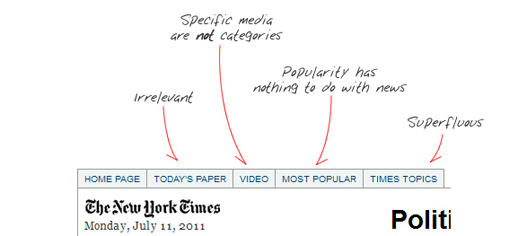
Andy Rutledge: What works and what doesn’t in news site design

US-based designer Andy Rutledge has written an excellent post on what works and what doesn’t when it comes to news site design and navigation. It is a must read for anyone remotely interested in how to present news on desktops and mobile.

You need to click though to this post in order to see all his comments when he describes what is wrong with the New York Times site. Here are a few points he makes after considering a number of digital news contributions.

  • Headlines should describe, inform, and be powerful. They should be the workhorse of the publication.
  • There is no ‘edition’. All news is global. All news is local. ‘Global Edition’ and ‘Local Edition‘, etc… are non sequiturs. Navigation and filters should be rational and easy to use.
  • There is no ‘most popular’ news. There is news and there is opinion and they are mutually exclusive. Popularity of stories is something not contextual to news sites, but to social media sites.
  • News is not social media. If it is, it fails to be news.
  • Those whose news reporting is of low quality avoid the marketplace and instead concentrate on the mob/opinion arena.

Rutledge goes on to make a case for charging for content saying “quality news is valuable” and “must therefore have a cost”. He then questions journalistic content.

Regarding content strategy and mechanism, today’s ‘news’ is rife with irrelevancies and distractions. Part of this is due to the news industry’s abandonment of actual journalism, but much of it is due to thoughtless promotional strategy and pathetic pandering. I suggest that digital news acquire a responsible and more usable approach. For instance:

  • ‘Featured’ sections are irrelevant, opinion-shaping editorial promotion; not news.
  • Headlines matter and can be scanned; intro text does not and compromises scanning.
  • Author, source, and date/time are important.
  • Opinion or Op Eds are distinct from news.
  • Article ratings or ‘likes’ are irrelevant in the context of news.
  • Comments are not contextual to news, but to social media
  • Media types (video, gallery, audio) are not sections. These are simply common components of each story.

The full post is at this link

Hat tip: The Next Web

Tags: , , ,

Similar posts:

Essential reading on how Google+ is shaping up

Much has been written about Google+over the past few days as it continues to grow at a record-breaking pace. Here are a few links from around the web on how Google+ is shaping up, plus this post on tips, tricks and tools for journalists using the social network.

What shape is Google+ taking?

The Guardian is reporting Google+ is approaching 20m users just three weeks since it launched as a rival to Facebook.

But “Google’s social juggernaut is beginning to show signs that it’s losing steam”, according to this post on Mashable.

In the Guardian article Paul Allen, the founder of Ancestry.com, said his calculations suggest Google+ is gathering 750,000 new users per day.

Allen explains his methods: “I don’t have access to log files or to a massive consumer panel. I’m simply measuring how many Google+ users there are of various randomly selected surnames every day. Last week I increased the sample of surnames that I query from 100 to 1,000.

Over a four-day period, the 100-surname sample showed a Google+ growth rate of 28.4 per cent. The 1,000 surname sample showed a growth rate of 28.5 per cent. [That's] statistically insignificant.

Mashable has a post looking at the key findings of a report by Experian Hitwise, which includes that 57 per cent of Google+ users are male.

Google+ is dominated by young adults. Its biggest age group for the four weeks ending July 14 was the 25-34 age bracket, which accounted for 38.37 per cent of all visits. The week before, the entire 18-34 age bracket made up just 38.11 per cent of total visitors.

Read Write Web has been taking a look whether Google+ is causing Twitter and Facebook useage to decline and, though the research methods are not scientific, the hunch is that Plus is having an impact on the use of its rivals.

That is a view seemingly shared by LinkedIn CEO Weiner. He thinks Google+ has changed the social landscape but there’s not much room left, according to a post on the New York Times.

Looking at the broad social landscape, Weiner said LinkedIn was for professionals, Facebook for family and friends, and Twitter for broadcasting short thoughts and information.

He noted that these three networks coexisting made for an “understandable landscape”, but when Google+ gets added to the mix, people have less time and will have to start making choices about where to spend that time.

“All of a sudden, you say ‘where am I going to spend that next minute or hour of my discretionary time?’ and at some point, you don’t have any more time to make choices,” Weiner said.

[He added] Google+ could follow Twitter in attracting celebrities and other well-known figures to help it become a more competitive service.

Some celebrities have already joined, and a couple are among the most followed people on Google+.

The Telegraph has been looking at who has the most followers. Many are Google bosses, plus there is blogger Robert Scoble and actress Felicia Day.

Over on the Next Web there are some thoughts on what Google+ means for your social media policy. The post states G+ is a gamechanger.

It’s all about the circles. Google+ actively encourages you to have ‘work’ and ‘friends’ as your circles. It’s a mindset shift. If you think about the user experience, Facebook is about sharing with friends and family. LinkedIn is about professional connections. Twitter allows you to choose for yourself what it’s about (see Getting past the Oprah Barrier for more about this). The Google+ user experience is all about the networks.

The Google+ experience is all about creating sub-networks of your life (circles) and populating those appropriately.

This means that users will gravitate towards having complicated, overlapping circles and the Google+ stream is a mix of personal and professional connections. This also means that the Google+ share box becomes a place where it is much easier to inadvertently share inappropriate content than perhaps the LinkedIn share box. From a policy perspective, that’s a whole lot of scary.

If you are a journalist and not yet on Google+ and would like an invite, fill in this form and I will attempt to invite you.
Tags: , , , , , ,

Similar posts:

#Tip of the day from Journalism.co.uk – How to shorten the URL to your Google+ profile

If you have managed to get an invitation for Google+, which launched a week ago, you may want to add your Google+ profile URL to your email signature or tweet it to your contacts.

The Next Web suggests using gplus.to, as technology correspondent for Channel 4 News Benjamin Cohen has done.

The Next Web reports that Google+ is due to launch its vanity URLs soon and has more details on how to shorten your Google+ profile URL.

Tipster: Sarah Marshall

If you have a tip you would like to submit to us at Journalism.co.uk email us using this link – we will pay a fiver for the best ones published.

Tags: , , ,

Similar posts:

© Mousetrap Media Ltd. Theme: modified version of Statement