Browse > Home /

#Tip of the day from Journalism.co.uk – best times to post on Twitter, Facebook and Tumblr

May 21st, 2012 | 1 Comment | Posted by in Top tips for journalists

Search Engine Watch has a post on the best times to post content via Twitter, Facebook and Tumblr. The post on social media optimisation states:

The best time to post content with a link on Twitter is 1 to 3pm EST Monday to Thursday. Over on Facebook, between 1 and 4pm mid-week is the sweet spot, while Tumblr users are more likely to click after 4pm and especially on Fridays.

The findings are based on graphs created by URL shortening service Bitly.

The article goes on to say:

Posting a link to Twitter after 3pm on a Friday is pretty much pointless, based on their cumulative data on the number of clicks on bitly links from each social network. Over on Facebook, traffic peaks mid-week, with Friday and weekend posts apt to receive far less attention. Posts between 8pm and 8am any day of the week are fighting an uphill battle for clicks.

The full post is at this link.

Tags: , , , ,

Similar posts:

Tool of the week for journalists – WhenToTweet

Tool of the week: WhenToTweet

What is it? A tool that allows you to work out the best time to tweet

How is it of use to journalists? 
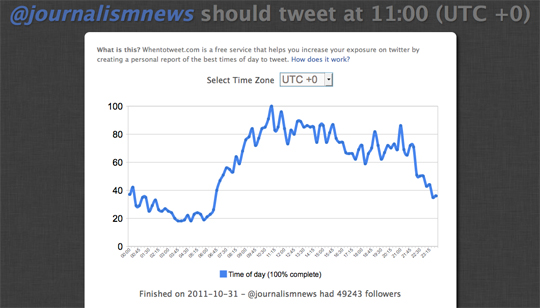
Automated tweets or those reporting breaking news cannot be timed. But when is the best time to engage with your followers and get noticed on Twitter?

In a recent interview for a podcast on how to best time your tweets, Leo Widrich, co-founder of Buffer, a platform that allows you to queue up tweets and post them at optimal times, explained that it is best to tweet when there is a lot of chatter.

When the most traffic happens and when the most tweets go out its the best time to tweet, which is sometimes counter-intuitive.

This tool works by both by monitoring the performance of your past tweets and tells you when most of your followers will be online. The best time for @journalismnews to tweet is 11am, according to this tool.

For more Twitter advice see 10 technical Twitter tips for journalists.

Tags: , , , , ,

Similar posts:

#Tip of the day from Journalism.co.uk: timing your Facebook posts

In Journalism.co.uk’s tech podcast tomorrow, Sarah Marshall will be looking at social media optimisation. Before that, here are some tips from PageLever’s Jeff Widman on Mashable for timing your Facebook posts to reach the largest number of people.

If you post often, you will see an immediate spike in News Feed impressions, but it’s generally not worth the cost in lost fans. When your fans see two status updates from you in their News Feeds, they’ll likely get annoyed, and will consequently unsubscribe or un-fan. There are few exceptions to this rule.

If you post too infrequently, you’re missing out on opportunities to reach your fans. Over the course of a year, a page with 10,000 fans that posts only half as often as they could misses more than 1 million chances to get their content in front of a hyper-targeted Facebook audience. The larger your fan page, the more often you should be posting — without annoying your fans.

See the full post on Mashable at this link.

Tipster: Joel Gunter

If you have a tip you would like to submit to us at Journalism.co.uk email us using this link – we will pay a fiver for the best ones published.


Tags: , , , ,

Similar posts:

Mashable: Five tools to better time your tweets

If you are trying to work out the best time to tweet about a news story and get maximum attention, it is worth making a note of the free applications listed in this Mashable post on five tools to help you work out the best time to send out tweets.

The post has been written by Leo Widrich, the co-founder of Buffer, an application which enables you to schedule tweets.

The five tools are:

1. WhenToTweet

2. TweetStats

3. Tweriod

4. TweetReports

5. TweetWhen

Add your Twitter handle to the various websites and the five tools will provide an interesting insight and help in your planning of social media optimisation (SMO) – (although we are not convinced 8am GMT on a Saturday is really the best time for @journalismnews to tweet).


Tags: , , , ,

Similar posts:

Mashable: How to work out the best time to post on your Facebook page

Social media optimisation (SMO) has joined search engine optimisation (SEO) as a term that journalists and news sites need to read up on.

SMO – as the name suggests – is all about how to work out when to time your tweets and Facebook posts so they get the most attention.

Mashable has an interesting post by Jeff Widman, the co-founder of PageLever, a Facebook analytics tool, which can help you work out how often and when to post news stories on Facebook:

I get asked all the time, “How frequently should I post on my Facebook page? When is the best time to post?”

Answer: Post whenever the most recent status update for your page stops showing up in your fans’ news feeds.

If you post often, you will see an immediate spike in news feed impressions, but it’s generally not worth the cost in lost fans. When your fans see two status updates from you in their news feeds, they’ll likely get annoyed, and will consequently unsubscribe or un-fan.

He goes on to explain the exceptions to the rule and how to calculate the lifetime of a post.

The full article on how to time your Facebook posts to reach the most fans is on Mashable.

You can also become a fan of Journalism.co.uk here on Facebook.

Tags: , , ,

Similar posts:

© Mousetrap Media Ltd. Theme: modified version of Statement