Browse > Home /

Malcolm Coles: Michael Jackson’s kids made the Daily Mail the most visited UK newspaper site in June

July 27th, 2009 | 1 Comment | Posted by in Comment, Newspapers, Search, Traffic

This is an edited cross-post from Malcolm Coles’ personal website:

The Daily Mail surprisingly overtook the Telegraph and Guardian in the June ABCes – with more unique visitors than any other UK newspaper.

However it was only 4th in terms of UK visitors. Figures from Compete.com, which tracks Americans’ internet use, suggest that, of the 4.7 million unique users the Mail added from May to June, 1.2 million were from the USA. American and other foreign visitors searching for Michael Jackson’s kids – the Mail tops google.com for a search on this – drove this overseas growth.

US traffic to UK newspaper sites
This is what happened to US traffic for the ‘big three’ UK newspaper websites from May to June, according to Compete.com’s figures:

This dramatic increase in traffic, compared to its rivals, from May to June helps explains how the Mail leapfrogged the Guardian and Telegraph.

Traffic leapt from May to July

Google.com was the main referrer to the Mail – responsible for 22.7 per cent of its traffic. More on this below. Next up was drudgereport.com [a large US news aggregation site], followed by Yahoo.com and Facebook.com.

What was behind this rise in US traffic?
So what led to this sudden increase for the Mail? Compete also shows you the main search terms that lead US visitors to sites.

Top five search terms that lead US visitors to the Guardian

  • Guardian/the guardian: 2.6 per cent
  • Michael Jackson: 0.9 per cent
  • Swine flu symptoms: 0.6 per cent
  • Susan Boyle: 0.6 per cent

Top five search terms that lead US visitors to the Telegraph

  • Michael Jackson: 2.5 per cent
  • Susan Boyle: 0.8 per cent
  • Swine flu symptoms: 0.7 per cent
  • Daily Telegraph: 0.6 per cent
  • Michael Jackson children: 0.5 per cent

Top five search terms that lead US visitors to the Daily Mail

  • Daily Mail/Dailymail: 9.9 per cent
  • Michael Jackson (or Jackson’s) children: 2.9 per cent
  • Michael Jackson’s kids: 1.3 per cent

What does this tell us?The main keywords driving US search traffic to the Mail
The Guardian’s top five search terms, as suggested by Compete.com, accounted for just 4.7 per cent of its search traffic. The Telegraph’s top five for 5.1 per cent.

But the Mail’s top 5 accounted for a massive 14.1 per cent – split between searches for its brand name and for Michael Jackson’s kids (and outside the top five there may have been many other MJ-related terms).

Its search traffic in June is heavily skewed to these two search terms in the USA – and elsewhere in the world, I think it’s reasonable to presume.

Can this last?
Searches in the USA for ‘Daily Mail’ have been fairly consistent over the last few months according to Google Insights. I don’t know why so many people do this compared to other newspapers.

But I do know that interest in Michael Jackson’s kids is going to die down. This graph shows how there was a huge and sudden surge in searches for his children and kids after he died. The graph shows just two search terms – there are likely to be many others, and so a significant proportion of the Mail’s overseas traffic increase is down to search terms related to Jackson’s offspring.

Searches for Michael Jackson and kids/children shot up

This increase in searches translates into traffic for the Mail because it is currently TOP for a search on ‘Michael Jackson children’ at google.com and 3rd for kids (it’s also top in Google India for a search on his children, and India is the next most common source of traffic to the Mail after the UK and USA).

So all this data suggests that the Mail’s top spot in June’s ABCes is built on US and other worldwide search traffic around Jackson’s children – the massive peak in late June and again around his funeral in early July.

Once people stop searching for these terms, this traffic will disappear. The Mail may still top July’s ABCes on the back of this traffic – but it’s hard to believe it will still be top in August.

Methodology
You can, of course, pick holes in this argument.

The three MJ’s kids search terms account for 4.2 per cent of Google traffic, which accounts for 22.7 per cent of 5.2 million visitors – so about 50,000 users.

But I think it’s reasonable to assume that there are more search terms outside the top five; there are other search engines; and that the other sources of traffic, such as people sharing links on Facebook and news aggregators, will also partially be about Jackson’s children.

Plus this is the only publicly available data that I’m aware of, and this is the story it seems to be telling.

Tags: , , , , , , , , , , , , , , , , , , , , , , , , , , , , , , ,

Similar posts:

#Tip of the day from Journalism.co.uk – finding search terms for your site

May 27th, 2009 | No Comments | Posted by in Search, Top tips for journalists

Search: If you’re setting up a new site, use Google’s AdWords Keywords tool to find out more about what search terms people use. They might not be the ones you think relating to your topic area, so will help you to decide the most appropriate. Tipster: Laura Oliver.

To submit a tip to Journalism.co.uk, use this link – we will pay a fiver for the best ones published.

Tags: , , , , , ,

Similar posts:

OJR: Search engine optimisation tips for online news start-ups

May 22nd, 2009 | No Comments | Posted by in Editors' pick, Search

Round-up of Danny Sullivan’s, editor of Search Engine Land, tips for new online news organisations on SEO. Including: creating standing pages for popular ongoing stories and issues; and discovering relevant search terms and keywords linking to your site.

Full list at this link…

Tags: , , , , , , ,

Similar posts:

CounterValue: Sun buys Natasha Richardson as sponsored link

Spotted by Justin Williams – The Sun has purchased ‘Natasha Richardson’ as Google keywords, following the death of the actress.

As raised when the Guardian mistakenly bought the search terms ‘Madeleine McCann’, how much is too much when it comes to search engine marketing?

Full post at this link…

Tags: , , , , , , , , ,

Similar posts:

Twitterfall makes it onto Telegraph newsroom screens

February 25th, 2009 | 15 Comments | Posted by in Handy tools and technology

Twitterfall, an app that lets you monitor new updates to Twitter on certain #tags or search terms, has been a fixture on the big screens in the Telegraph’s integrated newsroom for the last two weeks, according to this pic from Telegraph.co.uk editor Marcus Warren (courtesy of TwitPic):
Share photos on twitter with Twitpic

The Twitterfall of #twitterfall is the first non-mainstream media news source to appear on the screens, Warren said in a Tweet, adding that it’s the same size as the projection of Telegraph.co.uk on the screens and given more space than Sky, BBC and CNN on the wall.

Tags: , , , , , , , , ,

Similar posts:

Feeds feast for FT: new corporate RSS and FriendFeed experiment

January 6th, 2009 | No Comments | Posted by in Social media and blogging

(Try saying that headline 10 times fast)

First up, the Financial Times has announced a new RSS service for corporate users – an add-on for those paying subscribers who signed up for the site’s direct licence system introduced in April last year.

The customisable RSS feed will be available to corporate customers, who under the licence arrangement are entitled unlimited access to FT content on FT.com and third-party services, and can be tailored by specific search terms, a press release from the title said.

Not full-fat feeds as yet – users will click through to read articles on the main website.

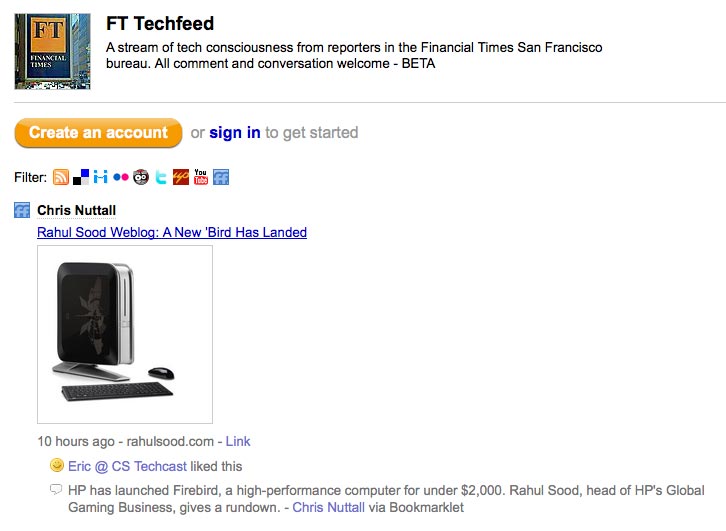
Elsewhere, technology journalists at the FT’s San Francisco bureau have been experimenting with FriendFeed to create a single source of their links, articles and blog posts (it can also be used for Twitter and Flickr updates):

Tags: , , , , , , , , , ,

Similar posts:

SIIA: iCopyright previews Discovery copyright tracking tool

September 11th, 2008 | No Comments | Posted by in Events

Mike O’Donnell, chief executive officer of iCopyright, gave Journalism.co.uk a sneak preview and an introduction to its new Discovery tool at the SIIA Global Information Industry Summit yesterday.

The tool scans public sites, including blogs, for reuse of a publisher’s content. The publisher can specify the search terms, e.g. how much of a match, how important the offending site is in terms of ad revenue, and how the application will contact and deal with the infringer.

Download:

A tool from iCopyright, which already handles copyright licensing for the Associated Press, is also being developed for bloggers and smaller, independent publishers, O’Donnell said.

Tags: , , , , , , , , , ,

Similar posts:

Innovations in Journalism: vtap – driving the ‘video-anywhere revolution’

August 20th, 2008 | 2 Comments | Posted by in Uncategorized

In our Innovations in Journalism series, Journalism.co.uk asks website and technology developers to pitch their projects to us. This time it’s Veveo with vtap, its personalised video service for mobiles.

1) Who are you and what’s it all about?
We’re Veveo – founded in 2004 by a team of executives with a history in multimedia, networking and mobile technologies.

Veveo’s mission is to be a driving force behind the ‘video-anywhere revolution’. The company’s flagship product, vtap is the first significant proof of concept. It offers consumers an easy way to browse, discover, keep and share videos from any source on any imaginable topic on the mobile device(s) of their choosing.

vtap indexes videos from all over the internet, including user-generated content (YouTube, DailyMotion) and professional sources (BBC, CNN), as well as blogs and corporate websites.

Basically, anywhere that video appears on the internet vtap indexes it and it is searchable for users.

To set up a personalised feed, users have to register (which is a simple process requiring only an email address and password).

They then enter search terms, which will bring up results or topics. These ‘topics’ can then be added to a feed, which allows users to log in and view relevant content at any time. This can also be viewed on their mobile phone.

By each video there is a ‘share’ button which enables users to send the video to another user, they just need to know the other person’s user name.

2) Why would this be useful to a journalist?
vtap is a great way to keep up-to-date with news and current events in an easy-to-view format. Because content is pushed to you on any device, you can keep up-to-date wherever you are.

3) Is this it, or is there more to come?
vtap is under constant development by our research and development team in Bangalore so there will be additional features in the near future.

We’re also working with mobile operators, mobile manufacturers, TV providers, consumer electronics manufacturers and content creators to deploy vtap solutions.

4) Why are you doing this?
Veveo believes that video content is the easiest way to get the content you want on a mobile, whether that’s news or entertainment.

To do this Veveo believes that users should be able to easily search videos from all over the web, and save and share what they find to create a personal TV channel.

This level of personalised service enables consumers to access the most relevant video content wherever they are, on any device.

5) What does it cost to use it?
vtap is a free service.

6) How will you make it pay?
vtap will be funded by an advertising model, details of which are yet to be announced.

Tags: , , , , , , , , , , , , , , , , , , ,

Similar posts:

Tip of the day from Journalism.co.uk: Do you know what your readers are searching for?

June 25th, 2008 | No Comments | Posted by in Search, Top tips for journalists

Online publishing: Do you know what people are searching for on your website? Check the logs for the most common search terms and see if what you are writing about matches what users want – you could be surprised. Tipster: Oliver Luft

Got a tip? Submit it here – we will pay a fiver for the best ones published.

Tags: , , ,

Similar posts:

OJR: Using Google Trends to fine-tune your news website

March 25th, 2008 | No Comments | Posted by in Editors' pick

Google’s tool can help online publishers tweak their content to maximize traffic from search engine users, says OJR.

‘Google Trends allows you to select up to five words or phrases, then shows you how those search terms rate relative to one another in both the volume of search queries handled by Google, as well as news references tracked by the search engine. It’s an addictive site for a data geek, like me, and essential for any online publisher who wants to optimize his or her publication to attract more visitors from search engines, such as Google.’

Tags: , , , , , , , ,

Similar posts:

© Mousetrap Media Ltd. Theme: modified version of Statement