Google+ is the first website to achieve 25 million users in four weeks and is growing at a rate of one million new users a day.
The social network launched on 28 June and achieved 25 million users on its four-week anniversary, according to a report from Reuters.
In contrast, it took Facebook about three years to attract 25 million visitors, while Twitter took just over 30 months, according to comScore.
While the data show Google’s latest attempt at breaking into social networking has started strongly, it may not mean the project is a long-term success. MySpace grew to 25 million unique visitors in less than two years – faster than Facebook or Twitter. However, it’s lost a lot of visitors in the past year, comScore data show.
One million people in the UK have signed up to join.
Google certainly has no shortage of services around the web, and its latest stab at social networking in the form of Google+ has been creating a greater buzz than the lukewarm reception of Google Buzz when it launched in February 2010.
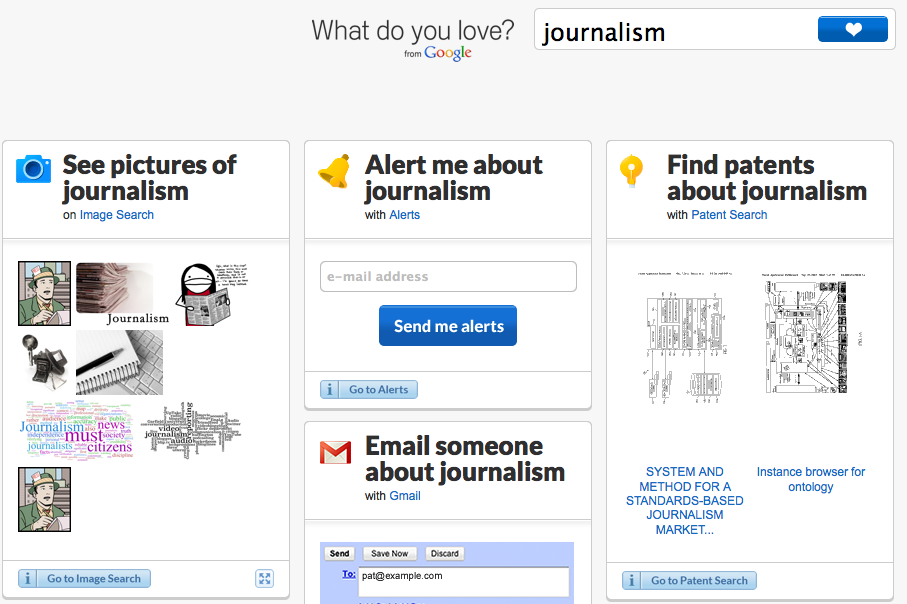
Also released with rather less fanfare is What Do You Love, a simple search tool that returns results from more than 20 Google services.
The site offers search in images, alerts, YouTube, books and maps among others, and renders the results on one page.
For example, a search for “journalism” gives you an option to find books about journalism, translate “journalism” into 57 different languages, call someone about journalism with Google Voice or search through related Blogger articles.
You can share the results via Gmail, Buzz or +1, but no third party sharing tools such as Facebook or Twitter are available.
The site is currently very unpolished – at the moment many of the results aren’t particularly accurate or helpful, but this may well improve with time.
For the moment it offers a nice idea that may return better results based on more specific keywords. In future it could also help with collecting a variety of content from different services about a single topic, rather than having to go through each site’s native search engine.
Google has launched a social network with some Facebook-like features. Google+ (plus) is open by invitation only to a very limited number of people while it is in the field test stage but Google has released details on its blog as to how it works.
One of its features is called ‘circles’, which allows users to categorise contacts and only share items with particular groups such as close friends and family but opt to exclude work contacts.
According to the New York Times, this is the “one significant way” in which Google+ is different from Facebook and the way “Google hopes will be enough to convince people to use yet another social network”.
It is meant for sharing with groups — like colleagues, roommates or hiking friends — not with all of one’s friends or the entire web. It also offers group text messaging and video chat.
The stream functions a lot like Facebook’s news feed — a flow of information shared by your friends. If Google+ grows to critical mass, news providers could find it very important to get their content into the stream.
The ‘sparks’ section is a bigger innovation. Essentially, sparks are topics that users designate an interest in. Google uses Google+ sharing activity and +1s, as well as its famous search algorithms, to recommend personalised content for each spark, according to Mashable.
Suddenly the +1 button makes more sense. Google announced +1 in March as a way for users to express approval of any web page. Now it seems the +1 button will infuse not only search results, but also sparks, with social recommendations. TechCrunch interviewed Google officials about Google+ and reports: “You’ll see a +1 button on all Google+ content — the +1 button clearly ties deeply into all of this. It is going to be their Facebook ‘like’ button.”
So Google appears to have released its tweet or like button before the social network to share it. A case of the cart before the horse?
Poynter’s post goes on to assess the potential usefulness of Google+ and how it could affect news consumption and delivery. It also states that there has been much scepticism about its success, following less successful attempts with social projects Google Buzz and Google Wave, but author Jeff Sonderman suggests there is hope for Google+.
It’s fair to say that Google+ appears to be different, more comprehensive and more well-planned than any previous effort. The design is great, the ideas sound good and the company is making a large commitment to success.
Marshall Kirkpatrick from ReadWriteWeb has tried it out – and he is impressed, describing it as a “smart, attractive, very strong social offering from Google”.
It is well worth reading his post after he spent a night with the new social network.
But the New York Times argues its Google+ project, which has seen huge investment, may have come too late
In May, 180 million people visited Google sites, including YouTube, compared with 157.2 million on Facebook, according to comScore. But Facebook users looked at 103 billion pages and spent an average of 375 minutes on the site, while Google users viewed 46.3 billion pages and spent 231 minutes.
Advertisers pay close attention to those numbers — and to the fact that people increasingly turn to Facebook and other social sites like Twitter to ask questions they used to ask Google, like a recommendation for a restaurant or doctor.
The article goes on to explain why Google+ has now come at this time, long after Facebook’s creation.
Larry Page, Google’s co-founder, regrets Google’s failure to lead in this market and has spent time working with the team since he became chief executive in April, people at the company say. He promoted [Vic] Gundotra to senior vice president this year, placing him on an equal level with the heads of Google’s core products like search and ads.
Part of the blame, analysts say, falls on Google’s engineering-heavy culture, which values quantitative data and algorithms over more abstract pursuits like socialising.
The consensus of blog posts seems to be another positive cultural shift for Google is strong design, as the Next Web reports.
Google+ and all that falls under its umbrella looks good — really good. The trademark minimalism is still present, but it’s been done with style (is that contradictory?) and is something to be appreciated.
That’s because interface designer Andy Hertzfeld, member of the original Apple Macintosh team, was given free reign over design decisions, AppleInsider reports.
Despite the headline, Hertzfeld is quoted in the piece describing the process and it seems he was not so much given free reign as he took it. “Better to ask forgiveness than permission” and so on.
Hertzfeld was worried that Larry Page wouldn’t like it with its animations and drag-and-drop fanciness, but “he loves it”.
A video overview from Google explains how Google+ works
Google is to introduce its +1 button to AdWords, the internet giant’s main advertising product, so users can recommend adverts to their friends and contacts.
Google’s button was added to AdWords on Google.com at the end of March and is now coming to Google.co.uk, according to an announcement on the AdWords blog.
Users who are logged into their Google account can click the button and their friends and contacts will see that news story or page promoted in their search.
In its US announcement, Google explains how the button works for Google AdWords.
Let’s use a hypothetical Brian as an example. When Brian signs into his Google account and sees one of your ads or organic search results on Google, he can +1 it and recommend your page to the world.
The next time Brian’s friend Mary is signed in and searching on Google and your page appears, she might see a personalized annotation letting her know that Brian +1’d it. So Brian’s +1 helps Mary decide that your site is worth checking out.
But almost a month on from news outlets adding the +1 button next to Twitter’s tweet button and Facebook’s like button (including on news stories on Journalism.co.uk), the button is very much third in line in terms of generating clicks.
So why are readers not using Google’s +1 button?
Unlike Twitter or Facebook where users post a link, those who click the button get little out of it in the same way they do by tweeting or liking a story – although that could change with the launch of Google +, a new social network dubbed Google’s answer to Facebook.
Making a recommendation is not immediate and there are several hurdles to overcome. For a contact to see a recommendation it relies on them searching for a keyword that the +1 user has shown interest in and the contact must also be logged into their Google account.
The button’s less than lukewarm take up also suggests people do not want their searches sorted by the choices made by their friends and contacts, but organised by relevance to what the wider online community is reading.
News sites get little out of +1 and although they may get a few more hits as a result, few would claim it has made any impact.
After a month on the article pages of news sites who opted to adopt +1, it is unlikely those who have not added the button will follow suit unless Google+ takes off in a big way. Those which have the button may decide to replace it with the LinkedIn share button, which has been gathering pace and is now coming in ahead of Facebook as a sharing mechanism on many sites, such as in this example from Mashable.
What do you think about Google’s +1 button? Let us know in the comments section below.
Google has three useful tools for journalists interested in looking at search trends over time, which also offer hours of fun for SEO enthusiasts. Google Correlate has been added to the list of analysis options within the past month, joining Insights and Trends which have been around for about three years.
Here is a brief introduction to each:
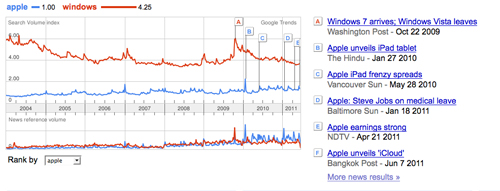
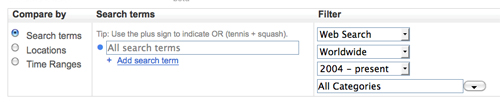
1. Google Trends works by you entering up to five search words and the results show how often those words have been searched for in Google over time. Google Trends also shows how frequently those search words have appeared in Google News stories, and in which geographic regions people have searched for them most.
For example, if you enter ‘Apple’ and ‘Windows’ you will see that ‘Windows’ is a far more popular search word, but when it comes to news, Apple appears in far more Google News stories. Evidence that journalists favour Apple stories than Windows ones, perhaps? Or do ‘Windows’ searches include vast numbers of people looking for double glazing?
Not only does Trends show you key events – such as the launch of the iPad – on the search volume time line, it also shows the volume of searches by country.
There is also a feature called Google Hot Trends which shows current searches and therefore hot topics. Combine google trends with SimilarContent tool for content optimization can help in Identifying the most relevant blogs for your target keyword, Identifying the most relevant news sites for your target keyword and Identifying the most relevant forums for your target keyword.
2. Google Correlate, launched by Google Labs at the end of last month, is like Google Trends in reverse.
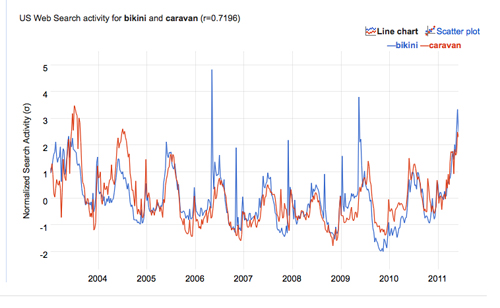
Correlate enables you to find queries with a similar pattern. You can upload your own data, enter a search query or select a time frame and get back a list of queries that follows a similar pattern to your search. You can also download the search results as a CSV file.
For example, if you enter the term ‘bikini’, Google Correlate will tell you a search term it closely correlates with is ‘caravan’, another being ‘Oakley sunglasses’. All are seasonal, so it is perhaps not that surprising those three searches correlate.
The inspiration behind Correlate was search patterns for flu (such as sore throat) correlating with peaks in actual flu activity. This comic book explanation tells the story brilliantly.
Another way of getting to grips with Correlate is having a go with this nifty drawing option. Simply drag and drop the pen and find out what searches match the time pattern you have drawn.
3. Google Insights is one step up from Trends in terms of being able to provide a more detailed search. Results can be easily embedded in news stories.
One of the many useful things about Insights is it can be used to determine seasonality. For example, a ski resort may want to find out when people search for ski-related terms most often.
To see the potential of Insights look at example search comparisons, such as this one for Venus Williams and Serena Williams.
On its official blog this week Google announced it was to start supporting “authorship markup — a way to connect authors with their content on the web”. According to the post this will enable websites to publicly link within their site from content to author pages.
For example, if an author at the New York Times has written dozens of articles, using this markup, the webmaster can connect these articles with a New York Times author page. An author page describes and identifies the author, and can include things like the author’s bio, photo, articles and other links.
According to Google it has worked with sites including the New York Times, the Washington Post, CNET and the New Yorker, prior to the launch of the markup to help get them set up. The markup will also been added to everything hosted by YouTube and Blogger, Google added.
For a more detailed description of how authorship works see the neat description below by the Search Engine Journal:
Sites that have large portions of content written by a specific author can denote the author of each piece of content and can specify the author’s page on the site. The author page can then include markup that specifies what select data on the page is. Google can then display portions of the specified data from the search engine results page, giving direct links to the author’s page, other content from the same writer, and other pages that belong to the same author (such as social sites).
Late on Friday Google announced the launch of ‘News near you’ for Google News on mobile, offering location-based news in its US English edition.
Location-based news first became available in Google News in 2008, and today there’s a local section for just about any city, state or country in the world with coverage from thousands of sources. We do local news a bit differently, analyzing every word in every story to understand what location the news is about and where the source is located.
Journalism conferences, as with all conferences I suspect, are always vulnerable to least a bit of tiresome industry navel-gazing, if not a lot. Even when they’re good, which the International Journalism Festival was, there is inevitably a lot of talking.
But on the last day of #ijf11 there was a welcome antidote in amongst the talk to round things off, a coherent message from several of the panelists: go out and do things, try things, find out what works. This particular session looked innovation in news, specifically at what it takes to go from having a good idea for a news site, to getting off the ground, to staying solvent.
Nigel Barlow trained as an accountant. He worked in small businesses for 20 years before he decided it was enough, and packed it in for a journalism course at UCLan.
Shortly after graduating Barlow co-founded Inside the M60, a local news site for the Manchester area. He told the #ijf11 panel that people need to start worrying less about the traditional journalism routes and start trying new things.
It’s a difficult time for journalism, but difficult times tends to bring out the best innovation. Don’t just look at the traditional routes, if you’ve got an idea just get on and do it. It’s abut throwing spaghetti at the wall and seeing what sticks.
A model example of getting on with it, Nigel was covering news for Inside the M60 before it even had a website.
Before the site was even there, we started to report on news in the area using Twitter, and created momentum for the site a few months before it launched.
We actively made connections with what I would call the local movers and shakers, MPs and businessmen for example.
We got a couple of big interviews with local MPs as well, which helped a lot at the beginning, and we were the first on the scene to cover a large gas explosion in Newham and were covering it live from the scene, after which we put about 1,500 followers in a couple of days.
We didn’t have a lot of money and we still don’t, so we have to make the most of free tools. But we got started by using social media and basically making a big noise on Twitter.
Using Barlow’s site as one example, Google News executive Madhav Chinnappa said the important thing was “the barriers to starting a news organisation have fallen”.
Fifteen years ago, starting a news organisation from scratch would have been impossible, but we have three people on this panel who have done exactly that.
And Chinnappa echoed Barlow’s sentiments on just getting on with it.
Google’s take on this is experimentation and interaction. Go out, try it, try it again, see what works.
He acknowledged it was difficult for smaller sites like Inside the M60 to get a decent ranking on Google news, and they would inevitably be dwarfed by the big global stories.
We know that if you’ve got a local news story that no one else has that it can be difficult to get out there. If you go to Google News and you don’t see an Inside the M60 story, that’s because they are getting outweighed by the likes of Fukushima and Libya.
And he acknowledged Google News was not giving proper due to certain types of content.
We’re not as good as we should be around video, or image galleries. And we’re almost playing catch up with the news organisations as they innovate, whether that’s graphics or slideshows.
But he also said there isn’t a magic formula to cracking Google, and argued that original, creative content was still important.
I think there is this myth about getting the technical aspect just right, and hitting on a formula and then you will suddenly be great on Google.
I don’t want to sound cheesy, but having good original content is still very important.
Over on Poynter Damon Kiesow looks at the “significant impact” this could have on the way publishers work to draw in visitors online.
For publishers, the result is that pages given a +1 by readers will appear more prominently in Google searches, and will be highlighted as recommendations by friends within the reader’s social network. That network only extends to Google products currently, but it is expected to include Twitter and other services in the future.
And in time publishers themselves will be able to put the +1 buttons on their own web pages, Kiesow adds.
When that does happen, it has the potential to swing the balance of power in the traffic referral battles back toward Google. In the past year, the search giant has seen Facebook increase its influence as a source of web traffic.