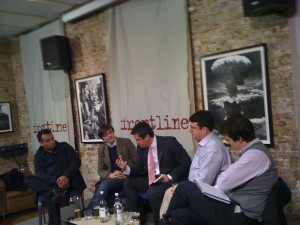
The Frontline Club has speedily posted its video of last night’s celebrity and media panel, featuring Jane Bussman, author of ‘The Worst Date Ever’; Popbitch founder Camilla Wright; Heat magazine editor and broadcaster Sam Delaney and Sharon Hatt, celebrity liaison at the National Autistic Society.
The verdict, the Frontline Club reports, was that, “if anything, the dominance of ‘slebs’ on public discourse and news media will only increase in the age of online social networking”.
It’s difficult to summarise this one fairly, so I’d urge you to follow the link and read the 11 comments – most of them mini-essays – in full, if you’re interested in the election, journalists and the influence of social media in politics. But mostly if you’re interested in the politics of journalism 2010.
The subsequent blog run-in is very illustrative of some of the ongoing tensions in newsrooms: the perceived regard held for online-only journalists or social media specialists; the tools-for-tools sake debate; and how (or how not) to prioritise social media in our work.
Maybe, like Anderson says, we need to start thinking about the impact of social media on the people not the journalism at these events, but in the meantime, this debate is worth a read.
Current director of global news at the broadcaster, Sambrook announced his departure in November. At the event he’ll discuss the people and events that have shaped his career in an on-stage interview with the BBC College of Journalism’s director Vin Ray.
MPs, Westminster hacks and activists might be addicted to expressing themselves in 140 characters or less, but don’t expect this year’s general election to be decided on which party has the best social media strategy.
Then again, politicians and the media shouldn’t dismiss voters’ digital engagement, according to a panel at a Frontline Club debate on the importance on social media for the upcoming election.
Twitter certainly has the potential to land politicians in mini-media storms; the panellists agreed: if David Wright MP had merely told a reporter verbally that Conservatives are “scum” it’s unlikely to have got much coverage, such is the continued novelty of Twitter to many news editors.
Paul Staines, better known as mischievous Westminster blogger Guido Fawkes, argued that no matter how well connected parties are, with Labour, Conservatives and Lib Dems towing similar centerist policy lines there was little to differentiate them for the ordinary voter: “If they are all marching in the centre ground, there’s not much to market, is there?”
And as for reporters, they’re “not going to get a scoop from Tweetdeck”, he warned. “There are about 500 of us (in the Westminster village) listening to each other aren’t there?”
Channel 4 News presenter Krishnan Guru-Murthy said social media buzz doesn’t determine what C4 leads its 7pm bulletin with – but Twitter got the network’s reporters in touch with someone in the audience at Nick Griffin’s notorious Question Time performance.
But all this is missing the point, according to Chris Condron, Press Association’s head of digital strategy:
If you ask any journalist what they think about a phenomenon like Twitter (…) they tend to think about what it means for journalists, but where its potential really lies is for audiences.
The “disintermediation” of news – where readers can go straight to the source of news, such as an MP’s Twitter stream – was a challenge for the media, but Condron is confident that “the reporters’ gathering and filtering of raw news was still essential.”
More events coming up at the Frontline Club:
Reflections with Richard Sambrook – a one-to-one conversation with the BBC’s outgoing director of global news. He’s headed for a new role as vice-president of PR firm Edelman, but how does he look back on a rich career and what is his view of journalism today?
Iraq: The Media Inquiry – a special panel discussion to examine the media’s reporting of Iraq since the invasion in 2003. With Nick Davies, author of Flat Earth News; Patrick Cockburn, The Independent’s Middle East correspondent and journalist David Rose. Moderated by Paddy O’Connell, presenter of BBC Radio 4’s Broadcasting House.
Insight with Timothy Garton Ash – the columnist and Oxford professor will be in conversation with Channel 4 News anchor Jon Snow will be in conversation with Channel 4 News presenter Jon Snow. Garton Ash will be talking about his career, the transformation of Europe over the last thirty years and what Barack Obama will mean for the United States and the world.
On the Media: Is the age of celebrity-obsessed media coming to an end? We discuss whether the ubiquitous presence of pseudo-famous faces on newspapers and news bulletins is here to stay. With comedian and journalist Jane Bussman; Popbitch founder Camilla Wright; Heat magazine editor and broadcaster Sam Delaney. Chaired by Robin Morgan, former editor of the Sunday Times magazine. This event is in association with the BBC College of Journalism.
“Aagh, it’s the attack of the snails!” is how Kevin Anderson, digital research editor at the Guardian described the news industry’s reaction to revenue destroying online technology – just what were publishers doing in the mid-90s when the web was first growing, he asked.
Anderson, who describes himself as a digital native since the web’s earliest days, joined a panel of fellow digital enthusiasts at the Frontline Club last night to discuss the dreaded ‘future of journalism’ question: RBI’s head of editorial development, Karl Schneider; Peter Kirwan, media columnist; and Ilicco Elia, head of mobile at Reuters Consumer Media.
Kirwan commented how few of the audience actually paid for news. Anderson also played the sceptical card, pointing out how the Guardian was looking to Guardian Professional and events for alternative funding streams.
Karl Schneider – who talked about the value of journalism in providing specific business services – said that 60 per cent of RBI’s revenue comes from online. The industry was “too negative” about the scope for digital advertising, he added.
But the most practical tips of the night came from Ilicco Elia, in our breakout groups: if you’ve got a website, build a mobile site. Don’t make it complicated, make it as simple as possible. (If you want pointers, he’ll no doubt be happy to help point you in the right direction: he’s @ilicco on Twitter.)
The crowd was as good value as the panel, with many of Journalism.co.uk’s favourite media bloggers: organiser Patrick Smith; Adam Tinworth from RBI; Kate Day, head of communities at the Telegraph; Martin Stabe, online editor at Retail Week; and Jon Slattery… of the Jon Slattery Blog.
Excitingly we also had chance to spot the newbie Guardian beat bloggers (who later headed off for dinner with Guardian Local mentor/boss Sarah Hartley and new colleague Kevin Anderson): Hannah Waldram (Cardiff); John Baron (Leeds) and Tom Allan (Edinburgh).
Foreign bureaux may be shrinking, but that doesn’t mean it’s all bad for journalists, says Rob Crilly, formerly of Nairobi and now working in Jerusalem.
“The days of the linen-suited staff foreign correspondent are gone. That’s sad and probably means foreign coverage is getting patchier. But it means there are more opportunities for motivated, well-organised and professional stringers – reporters who file to multiple outlets.”
Crilly shares ten tips for making it as a stringer, covering how to learn it, bust it, read it, meet it, blog it, slum it, structure it and flog it.
Publishers shouldn’t automatically give over everything to Google, said Moritz Wuttke, founder of NextMediaInitiatives, based in Switzerland and China, at a WAN-IFRA industry gathering today.
Wuttke, who advises media and advertising companies how to earn revenue online, suggested that newspaper publishers make advertisers work far too hard when it comes to buying adverts. It should be possible within three clicks, he said.
Who has tried to develop their own AdSense? Wuttke didn’t suggest that newspapers develop their own technology, but look to services outside of Google, he said. “Google is not bad – use them but don’t be abused,” he said. If Google offers to host everything for free, think twice, he advised.
“Work with Ad Clicks,” he said. “Start your own contextual advertising.”
Newspaper site advertising needs to be more flexible, he said. Understand that 15 seconds might be too long for a user to watch a advertising video – five seconds might even be too long, he added. “The best thing is to meet user groups and find out what is annoying,” he said.
Finally, he said: “Don’t fire the young guys. Hire the young guys – who will even work for free. Suck their brains. Empower them.”
Who? Digital editor and media trainer for Frontline Club.
What? Holliday started his online blogging site www.noodlepie.com, in 2004, while he was living in Saigon, Vietnam. As well as working for The Frontline Club, Holliday also blogs about food for the Observer Food Monthly blog Word of Mouth and for BBC Good Food.
Just as we like to supply you with fresh and innovative tips every day, we’re recommending journalists to follow online too. They might be from any sector of the industry: please send suggestions (you can nominate yourself) to judith or laura [at] journalism.co.uk; or to @journalismnews.
“Fighting in Gaza and Sri Lanka and the recent unrest in Iran all raised questions about how journalists can do their job when governments deny access (…) With the Israeli government relying more and more on public relations management and an increasingly sophisticated use of new media to get its message across, what is the role of the journalist in 21st century conflicts?”
The panel included Richard Sambrook, director of the BBC’s Global News division: Adrian Wells, head of foreign news, Sky News; and Jean Seaton Professor of Media History at the University of Westminster’s Communication and Media Research Institute