Browse > Home /

Media release: Sian Williams swaps BBC Breakfast for Radio 4

March 1st, 2012 | No Comments | Posted by in Broadcasting, Journalism

BBC Breakfast presenter Sian Williams is moving to Radio 4, after reportedly not wanting to move to the broadcaster’s new base at MediaCity in Salford, Greater Manchester.

The BBC said in a release today that Williams will join Radio 4′s Saturday Live magazine show from 5 May. Her last morning presenting BBC Breakfast will be on March 15.

Williams, who began her career on local BBC stations before moving to Radio 4 where she spent seven years as a senior producer, said in the release:

“I’m thrilled to be coming home to Radio 4. I spent many happy years as a producer here and have enjoyed presenting programmes on the network too. The opportunity to host Saturday Live with Reverend Richard Coles is too good to miss. It’s a warm and witty way to start the weekend and I can’t wait to be a part of the new team.”

The Telegraph notes today: “The announcement follows months of speculation about Williams’s future. She was among a number of BBC staff who refused to relocate to Salford, citing family reasons for her decision to remain in London.”

Tags: , , ,

Similar posts:

Independent: Watch the BBC newsroom from ‘Media Café’

February 24th, 2012 | No Comments | Posted by in Broadcasting, Journalism

The BBC is making a new step towards openness by building a cafe overlooking its new London newsroom, allowing the public to see what happens.

The vast multimedia newsroom in the basement of Broadcasting House will house 6,000 journalists and will be visible from the ground floor Media Café, which will accommodate up to 450 people.

The Independent reports: “The BBC hopes the initiative will provide a greater sense of interactivity with the public. In the United States, networks have often encouraged audiences to watch shows being broadcast from street-side studios.”

Tags: , ,

Similar posts:

BBC: Whitney Houston funeral coverage ‘reflected the significant interest’ in her death

February 22nd, 2012 | No Comments | Posted by in Broadcasting, Journalism

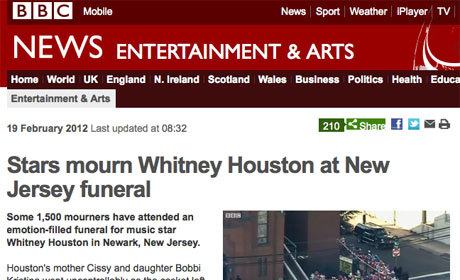
The BBC has issued a statement in response to complaints about the length of its live coverage of Whitney Houston’s funeral service.

The broadcaster reports that it received 118 complaints about its live coverage of the 3 and a half-hour service, which appeared on the BBC News channel.

Live coverage of the service began at 17:00 GMT and continued until just before 20:30 GMT, with the BBC continuing to report on the story afterwards.

In a statement, published by the BBC, the broadcaster said the coverage “reflected the significant interest in her sudden death as well as acknowledging the impact she had as a global recording artist”.

It acknowledged that “some people felt there was too much coverage” but said BBC One’s teatime bulletin, radio bulletins and other services had still given viewers “the best access to the day’s other news stories”.

Tags: , , ,

Similar posts:

The Register: Salford ‘teething problems’ lead to BBC errors

February 16th, 2012 | No Comments | Posted by in Broadcasting, Editors' pick

BBC insiders have spoken out about “endemic problems” with technology at the new MediaCity facilities in Salford, which have led to a series of errors including one unfortunate captioning mistake that saw a child being labelled as a recovering alcoholic.

“Once a mistake has been entered into the computer, the director in the TV gallery can do nothing to stop it. The software won’t allow it,” a source told The Register.

Other problems include failing clocks and non-responsive robotic cameras. The problems have so far affected BBC North West programmes, but BBC Breakfast is also moving into the studio complex shortly.

The BBC response is: “It wasn’t a technical error but rather just a simple case of people getting used to the new systems. With the introduction of any new systems, teething problems are to be expected.”

Tags: , ,

Similar posts:

Scotland on Sunday: Rangers bans BBC from press conference

February 13th, 2012 | No Comments | Posted by in Broadcasting, Journalism

Rangers football club, which filed for administration this afternoon, has banned the BBC from its press conferences as part of an ongoing row between the club and the broadcaster.

Scotland on Sunday reported yesterday that the BBC was banned from recording a post-match conference because of what the club described as “repeated difficulties” over its treatment by the broadcaster.

The paper said: “After the club’s 4-1 victory over Dunfermline Athletic, listeners to Radio Scotland’s Sportsound programme heard BBC reporter Chris McLaughlin state that a Rangers press officer had stopped him recording. A witness said: ‘He was asked to remove his microphone and the conference carried on.’”

Tags: , , , , ,

Similar posts:

BBC Editors’ Blog: Guidance on breaking news and Twitter

February 8th, 2012 | No Comments | Posted by in Editors' pick, Journalism, Online Journalism

After Sky News’s crackdown on Twitter use – and specifically retweeting non-Sky journalists – was revealed last night, it’s the BBC’s turn to clarify its position.

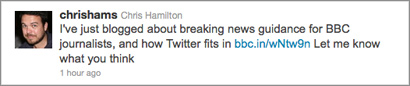
In a post on the BBC editors’ blog today, social media editor Chris Hamilton says the corporation has distributed some revised breaking news guidance to correspondents, reporters and producers.

It says that, when they have some breaking news, an exclusive or any kind of urgent update on a story, they must get written copy into our newsroom system as quickly as possible, so that it can be seen and shared by everyone – both the news desks which deploy our staff and resources (like TV trucks) as well as television, radio and online production teams.

We’ve been clear that our first priority remains ensuring that important information reaches BBC colleagues, and thus all our audiences, as quickly as possible – and certainly not after it reaches Twitter.

Tags: , ,

Similar posts:

Unions jointly submit pay claim for BBC staff

January 26th, 2012 | No Comments | Posted by in Editors' pick, Journalism

The National Union of Journalists, Bectu and Unite have jointly issued a pay claim for BBC staff for 2012 to 2013, which according to union statements, asks for a rise “of RPI plus two per cent, with a minimum increase of £1,000″.

The NUJ says this would apply to BBC staff in bands two to 11. In a statement the NUJ’s broadcasting organiser Sue Harris said they consider it “a fair claim”.

According to the unions the claim “also seeks the reinstatement of a previous right for staff to lodge pay appeals” and “encourages BBC management to agree to the inclusion of elected staff representatives on the Executive Remuneration Committee”.

Read more on the pay claim on the NUJ and Bectu websites.

Tags: , , , , ,

Similar posts:

Ten examples of games used to tell news stories

December 16th, 2011 | No Comments | Posted by in Multimedia, Online Journalism

One of the sessions at news:rewired – media in motion will look at how newsgames and gaming mechanics are being used in journalism.

Shannon Perkins, editor of interactive technologies at Wired.com and who created Cutthroat Capitalism, a game where the player puts themselves in the position of a Somali pirate, will be coming over from the US to speak at news:rewired. In a Journalism.co.uk podcast he said a reader should “develop a deeper sense of the underlying themes of a story” by playing a game.

Another speaker presenting in the newsgames session at news:rewired is Bobby Schweizer, a doctoral student at the Georgia Institute of Technology and co-author of Newsgames: Journalism at Play. He will also be joining us from the US.

Here is a list of 10 newsgames to give an idea of how games can be used in storytelling.

1. The world at seven billion (BBC)

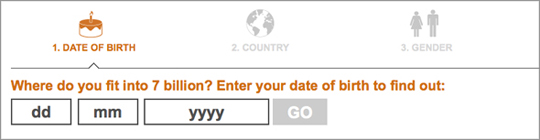
This BBC interactive, which uses gaming mechanics, is proof that newsgames go viral. The world at seven billion was the most shared and “liked” news story on Facebook of 2011 with 339,149 shares, comments and likes. It was also the most clicked story on Facebook this year and was the fourth most popular news story on Twitter in 2011 with 73,783 tweets.
2. Charlie Sheen v Muammar Gaddafi: whose line is it anyway? (Guardian)

A newsgame was also the second most popular news story on Facebook in 2011, with 219,023 shares, likes and comments. It is the Guardian quotes quiz where readers are asked to guess whether a line is a quote from former Libyan leader Muammar Gaddafi or actor Charlie Sheen.

This one was “produced very quickly”, according to the Guardian, and is an idea that could inspire small news organisations without a budget for big game development.

3. Cutthroat Capitalism (Wired.com)

This newsgame was created by news:rewired speaker Shannon Perkins after reading an article in Wired Magazine. The player becomes a Somali pirate. The game states:

You are a pirate commander staked with $50,000 from local tribal leaders and other investors. Your job is to guide your pirate crew through raids in and around the Gulf of Aden, attack and capture a ship, and successfully negotiate a ransom.

4. Los 33 (Chilean miners) (Chilean design firm Root33)

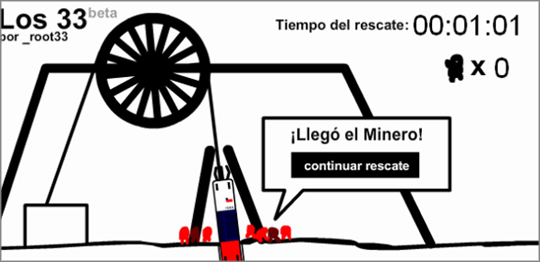
This newsgame is based on the rescue of the Chilean miners trapped underground in 2010. According to Bobby Schweizer, who will be speaking at news:rewired, the game, which asks the player to rescue the miner, provides an insight into the slow process involved in rescuing each miner.

You perform the rescue 33 times if you want to finish the game – which is impossible really to complete. It’s trying to get across that concept that maybe you can’t explain in a written article.

When you see video clips edited together of each of the miners returning to the surface you have three to five seconds of each of their faces, you don’t get that real sense of how long it actually took. The game was able to express that in the way that other stories couldn’t.
5. How should I vote in the General Election? (Telegraph)

This is a game produced by the Telegraph. It asks users to answer a series of questions to find their values and concerns. The game then cross-checks responses with party pledges and the player is then told how they should be voting. This game received much attention as voters were often surprised by the results the game returned.
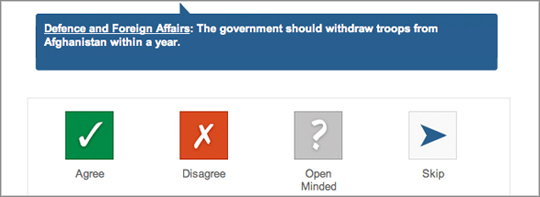
6. The budget calculator (most major news sites)

Perhaps the most widely used form of gaming mechanics used in news is the budget calculator. The viewer enters a salary, the fuel-type of their car, amount of alcohol units consumed per week and other details and then gets told how much better or worse off they will be based on the new budget.

This budget calculator from the BBC shows gaming mechanics in online news is nothing new – going back at least 10 years. Here are BBC examples from 2002, 2003, 2004, 2005, 2007, 2008, 2009, 2010 and 2011.

7. Christmas on the high street: retail winners and losers (Guardian)

At the beginning of this year the Guardian produced an interactive based on the Monopoly board. By clicking on each retailer the player finds out how business faired last Christmas.

8. Obameter (PolitiFact)

PolitiFact also uses gaming mechanics, such as with its Obameter, which tracks the US President’s campaign promises, the Truth-O-Meter (which also comes in app form) to test politicians’ and the GOP Pledge-O-Meter to rank political promises.

Speaking at the World Editors Forum in October founder and editor of the site Bill Adair said he felt there was “a tremendous lack of imagination” in the news industry in how to take advantage of new publishing platforms.

It’s like we’ve been given a brand new canvas with this whole palette of colours and we’re only painting in grey. We need to bring all the other colours to this new canvas.

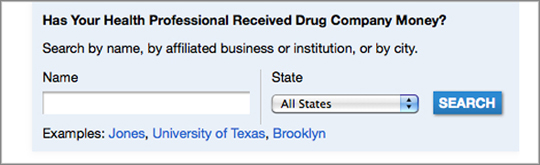
9. Dollars for Docs (ProPublica)

US investigative news site ProPublica regularly uses gaming mechanics in news stories, such as with Dollars for Docs which enables people to find out whether their health professional has received money from drugs companies. Speaking at the World Editors Forum Scott Klein, editor of news applications, told the conference that as well as adding context, a news app has the ability to personalise and place the user at the centre of the story and offer them the ability to see the impact on them. “It doesn’t just tell a story, it tells your story,” he said.
10.  Fix the deficit (New York Times)

Here’s a budget puzzle from the New York Times. The reader is asked to work out where to make spending cuts to balance the books and hopefully get a sense of the financial challenges, tough decisions and the size of the shortfall.

Want to find out more about newsgames? Book a ticket for news:rewired here.

Recommended reading, viewing and listening:

This is a cross-post from news:rewired.

Tags: , , , , , , ,

Similar posts:

Top 10 Twitter news stories of 2011

December 8th, 2011 | No Comments | Posted by in Social media and blogging, Traffic

After taking a look at the top 10 Facebook news stories of 2011 yesterday, today we are publishing a list of the year’s top Twitter stories.

This list is based on data from SEO and social data tool Searchmetrics.

A liveblog makes it in at number two, plus there are photo stories and a news game (see number four).

1. Independent: Why the Fukushima disaster is worse than Chernobyl = 83,529

2. BBC: LIVE: Osama Bin Laden dead = 77,853

3. Mail Online: The big pictures: The moment Japan’s cataclysmic tsunami engulfed a nation =  74,835

4. BBC: The world at seven billion = 73,783

5. BBC: Apple holding more cash than USA = 70,202

6. Guardian: Top 100 women = 48,250

7. BBC: Malawi row over whether new law bans farting = 38,861

8. Mail: Back from the dead: Astonishing pictures show how Japan is recovering just three months after tsunami = 31,750

9. BBC: Spelling mistakes ‘cost millions’ in lost online sales = 28,253

10. BBC: Sacrebleu! = 27,377

Data was gathered using Searchmetrics and downloaded for analysis on 6 December. The news outlets included were: BBC, Guardian, Telegraph, Independent, Mail Online, the Sun, the Mirror. You can see the downloaded Twitter data here.

Tags: , , , , ,

Similar posts:

Top 10 Facebook news stories of 2011

December 7th, 2011 | No Comments | Posted by in Social media and blogging, Traffic

Facebook last week published a list of the most shared articles on Facebook in 2011. That list included only US publishers – so we decided to create a list of the most shared, liked and commented articles from UK news outlets.

This list is based on data from SEO and social data tool Searchmetrics.

As with the US list, stories range from hard news to quirky (or “cute”, as Facebook describes them). Interestingly, the two top stories are newsgames, where the reader is invited to participate using gaming mechanics. (It’s worth mentioning here that there will be a session on newsgames and gaming mechanics at our news:rewired conference for journalists, for which the agenda is here.) The list also includes online video (another news:rewired topic).

The top 10 most shared, commented and liked Facebook news articles of 2011:

1. BBC: The world at 7 billion = 339,149 (shares, comments and likes)

2. Guardian: Charlie Sheen v Muammar Gaddafi: whose line is it anyway? = 219,023

3. Mail Online: Amy Winehouse, 27, found dead at her London flat after suspected ‘drug overdose’ = 190,498

4. BBC: Austrian driver allowed ‘pastafarian’ headgear photo = 167,754

5. BBC: Japan earthquake: Tsunami hits north-east = 159,023

6. BBC: Breast milk ice cream goes on sale in Covent Garden = 149,509

7. BBC: Osama Bin Laden, al-Qaeda leader, dead – Barack Obama = 146,244

8. BBC: Drunk Swedish elk found in apple tree near Gothenburg = 146,182

9. Mail Online: Robber who broke into hair salon is beaten by its black-belt owner and kept as a sex slave for three days… fed only Viagra = 145,413

10. BBC: London rioters: ‘Showing the rich we do what we want’ = 131,839


Top 10 most shared news articles on Facebook in 2011

1. BBC: The world at 7 billion = 147,000

2. Guardian: Charlie Sheen v Muammar Gaddafi: whose line is it anyway? = 65,820

3. BBC: Japan earthquake: Tsunami hits north-east = 60,238

4. BBC: Austrian driver allowed ‘pastafarian’ headgear photo = 54,800

5. BBC: Drunk Swedish elk found in apple tree near Gothenburg = 44,700

6. BBC: Osama Bin Laden, al-Qaeda leader, dead – Barack Obama = 38,891

7. BBC: Speed-of-light results under scrutiny at Cern = 36,700

8. BBC: London rioters: ‘Showing the rich we do what we want’ = 36,500

9. Mail Online: Meet the blind Great Dane in need of a home (but you’ll need to make space for HER huge guide dog) = 34,600

10. BBC: Amy Winehouse: Tributes paid to dead singer = 31,400


Top 10 most ‘liked’ articles on Facebook

1. BBC: The world at 7 billion = 75,619

2. Mail Online: The 9/11 rescue dogs: Portraits of the last surviving animals who scoured Ground Zero one decade on = 62,458

3. BBC: Austrian driver allowed ‘pastafarian’ headgear photo = 61,306

4. BBC: Drunk Swedish elk found in apple tree near Gothenburg = 51,618

5. BBC: Osama Bin Laden, al-Qaeda leader, dead – Barack Obama = 49,882

6. BBC: The world at 7 billion = 47,449

7. Mail Online – Beauty in every grain: For the first time remarkable photographs reveal hidden charms of ordinary SAND = 43,760

8. Mail Online: Robber who broke into hair salon is beaten by its black-belt owner and kept as a sex slave for three days… fed only Viagra = 42799

9. Mail Online: Cheeky monkey! Macaque borrows photographer’s camera to take hilarious self-portraits

10. The Sun: Frankie Cocozza 
kicked off X Factor


Top 10 most commented news articles on Facebook in 2011

1. Mail Online: Amy Winehouse, 27, found dead at her London flat after suspected ‘drug overdose’ = 127,396

2. BBC: The world at 7 billion = 116,530

3. BBC: Breast milk ice cream goes on sale in Covent Garden = 108,258

4. Guardian: Charlie Sheen v Muammar Gaddafi: whose line is it anyway? = 105,754

5. BBC: London rioters: ‘Showing the rich we do what we want’ = 73,350

6. BBC: Amy Winehouse: Tributes paid to dead singer = 72,313

7. Mail Online: Robber who broke into hair salon is beaten by its black-belt owner and kept as a sex slave for three days… fed only Viagra = 71,514

8. BBC: Japan earthquake: Tsunami hits north-east = 68,830

9. Independent: US preacher warns end of the world is nigh: 21 May, around 6pm, to be precise = 67,388

10. BBC: Speed-of-light results under scrutiny at Cern = 59,824

Data was gathered using Searchmetrics and downloaded for analysis on 6 December. The news outlets included were: BBC, Guardian, Telegraph, Independent, Mail Online, the Sun, the Mirror. You can see the downloaded Facebook data here.

Tags: , , , , , ,

Similar posts:

© Mousetrap Media Ltd. Theme: modified version of Statement