Browse > Home /

| Subscribe via EMAIL | Or RSS

NowGamer.com takes website to next level

February 23rd, 2009 | No Comments | Posted by Hannah Stuart-Leach in Magazines, Online Journalism

Video gaming website NowGamer.com was launched by publisher Imagine Publishing on Friday. The site is the first in a series of ’supersites’ from the company to go live in the next couple of years, according to a release from the group.

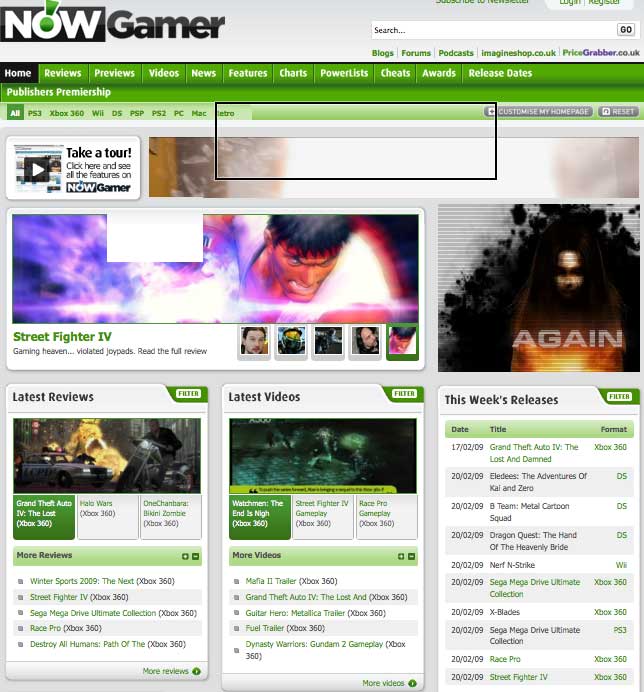
NowGamer.com homepage

The clean, easy-to-navigate site was created with Bedford-based technology partner, Evolving Media and, unlike most gaming websites, it avoids a typically overcrowded, hectic layout.

The stand-out thing about NowGamer.com though it allows you create your own personal space of sorts:

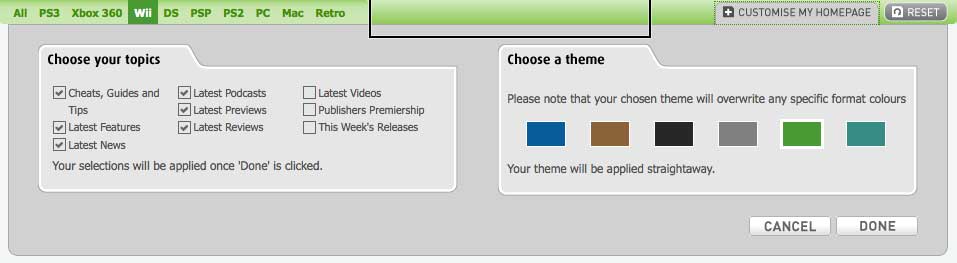
NowGamer.com allows you to customise your profile

Users can drag and drop different content widgets around the homepage, ranging from podcasts to previews, and reposition each element according to their interest – or even just delete it if they see fit.

Users can also redefine the content so that it only includes material relevant to the video games platform they use, be it Nintendo Wii or iPhone.

This modern, mature approach is also combined with a wealth of expert knowledge. The people behind the site, from Imagine, have all had a  history in the field of video games journalism, working on titles including SegaPro and 360 in the past. The site is also able to make use of Imagine Publishing’s extensive back catalogue which started in 1995.

Although only formed in May 2005, Imagine Publishing is already responsible for 25 websites and 20 magazines.

Tags: , , , , , , , , ,

Similar posts:

Financial Post apologises for reporter’s Twitter outburst

February 12th, 2009 | No Comments | Posted by Laura Oliver in Online Journalism

Canadian title the Financial Post published an apology on its website yesterday for an unnamed reporter’s conduct on Twitter:

An apology
Posted: February 11, 2009, 6:18 PM by NP Editor

Today, a Financial Post reporter responded unprofessionally to another Twitter user on his personal Twitter account.

While the remarks were made on the reporter’s personal Twitter account, the conversation first began when the reporter was acting in his capacity as a reporter for the Financial Post.

We hold – and will continue to hold – all our reporters to a higher standard in how they address anyone, in any forum.

We apologize for the reporter’s conduct.

The reporter in question seems to be @sirdavid (David George-Cosh) who engaged in battle with marketing professional @aprildunford – neatly summed up by Ian Capstick on his MediaStyle blog.

Dunford has drawn a line under the Twitter furore in a blog post, which remphasises why social media needs social awareness – basic manners apply here too.

Interesting to note in the Post’s apology the blurring lines between personal and private. We’ve seen guidelines set out before about journalists and professional/public profiles on social networking sites for example, but the debate seems to be moving onto Twitter.

Most journalists (or other professionals for that matter) would see this as obvious – don’t have an outburst like that full stop. But where does the personal become the public? The Post makes the connection because this conversation started on a work issue – but is it always that easy to draw the line?

Tags: , , , , , , , ,

Similar posts:

Ten things every journalist should know in 2009

1. How to use Twitter to build communities, cover your beat, instigate and engage in conversations.

2. How to use RSS feeds to gather news and manage them using filtering techniques (basic or advanced).

3. That there is a difference between link journalism and ‘cut and paste’ journalism (aka plagiarism).

4. That your readers are smarter than you think. In fact, many are smarter than you – they know more than you do.

5. That churnalism is much easier to spot online. If you do this regularly, your readers are already on to you – merely re-writing press releases without bringing anything to the table no longer cuts it.

6. Google is your friend. But if you are not using advanced search techniques, you really have no idea what it is capable of.

7. You do not have to own, or even host, the technology to innovate in journalism and engage your readers. There is a plethora of free or cheap tools available online, so there is no excuse for not experimenting with them.

8. Multimedia for multimedia’s sake rarely works, and is often embarrassing. If you are going to do it, either do it well enough so it works as a standalone item or do it to complement your written coverage – for example, add a link to the full sound file of your interview with someone in your article, or a link to the video of someone’s entire speech at an event. The latter will enhance the transparency of your journalism too. Great tips and resources here and some useful tips on doing video on a budget.

9. How to write search engine friendly journalism. Old school thinking about headline writing, story structure etc no longer applies online and there is also more to learn about tagging, linking and categorisation. Sub-editors (if you still have them), editors and reporters all need to know how to do this stuff.

10. Learn more about privacy. You can find a lot of information about people online, especially via social networking sites, but think carefully about the consequences. And bear in mind that it cuts both ways, if you do not do it carefully, your online research could compromise your sources.

Tags: , , , , , , , ,

Similar posts:

Tip of the day from Journalism.co.uk – publicise your blog

September 1st, 2008 | No Comments | Posted by Laura Oliver in Top tips for journalists
Blogging: Don't just publish on your blog - spread the word on forums, social networking sites, Twitter etc. You can even create a Facebook page just for your blog. Tipster: Neil Macdonald To submit a tip to Journalism.co.uk, use this link - we will pay a fiver for the best ones published. Full story...

Tags: , ,

Similar posts:

Spleak launches new online communities

July 22nd, 2008 | No Comments | Posted by Laura Oliver in Social media and blogging

California-based startup Spleak Media Network has launched three new online applications for fashion, TV and gaming communities.

StyleSpleak, TVSpleak and GameSpleak will work in the same way as the company’s existing sites by providing short-form news and gossip updates alongside comments and contributions from users, and content from partnered media organisations such as Hearst Digital.

The Spleak applications are available on instant messaging platforms, social networking sites and mobile phones.

Tags: , , ,

Similar posts:

Tip of the day from Journalism.co.uk – Employees: take care on social networks

July 15th, 2008 | No Comments | Posted by John Thompson in Top tips for journalists

Jobseeking: If you are seeking a serious career, be very careful about your use of social networking sites. Employers can and do check sites like Facebook and MySpace to find out more information about you. Tipster: John Thompson

Got a tip? Submit it here – we will pay a fiver for the best ones published.

Tags: ,

Similar posts:

Tip of the day from Journalism.co.uk: Get your case studies from social networks

June 4th, 2008 | No Comments | Posted by John Thompson in Top tips for journalists

Case studies: Online forums and groups on social networking sites can be a goldmine. Make contact individually or send out a group message depending on the sensitivity of the request and be polite – these are like members clubs. Tipster: Laura Oliver

Got a tip? Submit it here – we will pay a fiver for the best ones published.

Tags: , , ,

Similar posts:

Social Media Journalist: “Our future isn’t traditional online but in mobile media platforms,” Steve Smith, Spokesman-Review

Journalism.co.uk talks to reporters across the globe working at the collision of journalism and social media about how they see it changing their industry. This week, Steve Smith from The Spokesman-Review, USA.

Steve Smith, editor of the Spokesman-Review

1. Who are you and what do you do?
I am the editor of The Spokesman-Review, a 90,000 circulation daily serving several counties in eastern Washington state and north Idaho.

As editor, I supervise all news and editorial operations, including our website, our other digital platforms and our radio operations.

I have a staff of 124 full-time employees in the newsroom and an annual budget of about $9 million. I have been here since July 2002.

Before coming here, I worked in a variety of roles at seven other newspapers in six different cities.

2. Which web or mobile-based social media tools do you use on a daily basis and why?
I use YouTube daily because we post all of our multimedia on the site and also are capable of embedding YouTube videos on our blogs, including my blog, “News is a Conversation”.

I use MySpace and Facebook when hiring. We check the profiles/pages of prospective employees and actually have rejected applicants because of questionable behavior observed on their pages.

I also go into MySpace frequently to check on the pages devoted to our entertainment magazine, “7″.

In addition, I check several industry blogs daily. Several times a day, I check Romenesko, the must-read industry blog on the Poynter Institute for Media Studies site.

I do very little of this on my mobile, though I do use it for blog work, reading and posting.

I’m still somewhat of a troglodyte (no MySpace page of my own) so I don’t use the mobile to access video or social networking sites.

The Spokesman-Review is the pioneer newspaper (in the United States at least) for transparency. Our transparent newsroom initiative is built around interaction with people in our communities. Blogging and the various blogging tools are critical to us.

We also webcast news meetings and provide as much two-way interaction as possible via chats and other real-time opportunities. Increasingly, we’re developing transparency systems that work on mobile devices.

3. Of the thousands of social media tools available, could you single one out as having the most potential for news either as a publishing or a news gathering tool?
Blogging from the field has the most potential for us at the moment. We’re in the process of developing ideas for 7 that would have real non-media people posting live reports from concerts, nightclubs and other events.

We’re also involved in some beta proposals for training citizen journalists and giving them publishing platforms.

I have no idea where all of this will lead. We’re experimenting with some developing Google applications such as Google Maps and Google Street View to see how they might enhance our blogs.

4. And the most overrated in your opinion?
Tough question. I am willing to try anything with any tool. Until something proves to be useless, I won’t dismiss it.

I do believe our future isn’t in traditional online but in mobile media platforms, the potential of which is yet to be understood. That may drive us to networking tools that enhance the mobile experience.

To reference one single overrated tool, as it were, I’d have to mention Wikipedia. There is an enormous amount of information there. I go to the site often for informal searches. But journalists beware. It is a bottomless quicksand pool that will easily send reporters and editors off in the wrong direction, at best wasting time and, at worst, producing factually inaccurate, even humiliating journalism.

Tags: , , , , , , , , , , , , , , , , , , , , , ,

Similar posts:

Tip of the day from Journalism.co.uk

February 22nd, 2008 | No Comments | Posted by John Thompson in Search, Top tips for journalists

Slick searching: Intelways.com lets you run a search using dozens of tools in several categories such as search engines, social networking sites and niche sources. Tipster: Colin Meek

Got a tip? Submit it here – we will pay a fiver for the best ones published.

Tags: , , , ,

Similar posts: