Browse > Home /

| Subscribe via EMAIL | Or RSS

Why the iPad isn’t the saviour of journalism as we know it

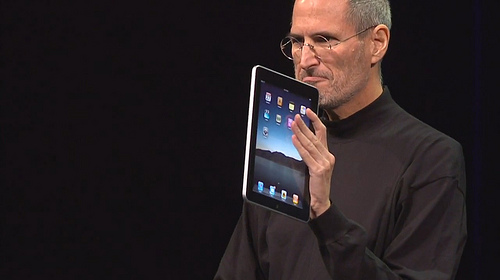
The hype surrounding Apple’s new touch-screen mini-computer, predictably, is huge. Just like film studios, book and textbook publishers, news producers are hoping the iPad can boost the online, mobile content marketplace.

Here’s a “source”, who purports to have worked with Apple CEO Steve Jobs, telling the Wall Street Journal exactly what it wants to hear:

Mr. Jobs is “supportive of the old guard, and [he] looks to help them by giving them new forms of distribution”.

One publishing CEO was even moved to write poetry about it (via Moconews.net) and Apple fanboys and news executives will no doubt be glued to their screens when Jobs takes the stage at around 6pm (GMT) tonight to announce the details.

But when the hype dies down, will the journalism business really be in better shape? These people have taken a welcome dose of reality juice:

  • Craig McGill, a former journalist now plying his trade at digital PR firm Contentlymanaged, quite reasonably asks who is going to create all the content for new organisations’ multiplatform mobile packages given all the job cuts in news publishing in the past year.
  • Forrester analysts Charles Golvin and James McQuivey consider that maybe the iPad won’t be all it’s cracked up to be: “It is flawed in meaningful ways: It’s a computer without a keyboard, it’s a digital reader with poor battery life and a high price tag, and it’s a portable media player that can’t fit in a pocket.” (via paidContent.org)
  • I couldn’t put it better than David Campbell, a professor of cultural and political geography, did this morning: “Information and distribution are separate. Journalism is information, tablet distribution. Can help journalism circulate but can’t ’save’ it.”

Much is made of iTunes and its successful monetisation of mobile applications and music – the Financial Times is even planning to imitate (via PCUK) its “pay-per-view” micropayments model, although FT.com told Journalism.co.uk last week that paid-for day passes would come first.

The model is attractive: there are more than 100 million iTunes accounts with users’ credit cards pre-loaded and ready to go. A new shiny, powerful device – somewhere between an e-reader and a netbook – could just persuade people to buy the news subscriptions the New York Times and Rupert Murdoch so desperately want to sell them.

But Apple’s new device is just another distribution platform for words, pictures, videos and data, just like PCs, mobiles and print. Recreating a print experience on another device is not going to solve the economic crisis news finds itself in: Google will still be more efficient at selling advertising and will still point readers to free content.

The future of news is about distributing content as widely as possible and monetising not just content but relationships. Devices will be a big part of that, but they’re not the answer.

Photo credit: Mike McCaffery, from Flickr, via a Creative Commons licence.

UPDATE: This post was amended to reflect the announcement of the name of the device, iPad.

Patrick Smith is a freelance journalist and event organiser, and formerly a correspondent for paidContent:UK and Press Gazette. He blogs at psmithjournalist.com and is @psmith on twitter.

Reblog this post [with Zemanta]

Tags: , , , , , ,

Similar posts:

The New York Times and the tablet

This New York Times piece on print media’s hopes for the Apple Tablet, confirms that the company is developing a version of the paper for the tablet, but adds little detail:

The New York Times Company, for example, is developing a version of its newspaper for the tablet, according to a person briefed on the effort, although executives declined to say what sort of deal had been struck.

The New York Times has, however, announced its new ‘reader applications’ division:

On Monday, The Times also announced that its media group division had created a new segment for “reader applications,” and named Yasmin Namini, the senior vice president for marketing and circulation, to head it. Executives said the timing was coincidental, prompted not by the Apple device specifically, but by the growing importance to The Times of electronic reading devices in general.

The LA Times, meanwhile, reports that the New York Times is developing a large-screen version of the iPhone app – from Apple HQ:

Apple has been slowly amassing digital reading material for the forthcoming device. A team from the New York Times has been working in Apple’s Cupertino, Calif., headquarters in recent weeks, developing a large-screen version of the newspaper’s iPhone application that incorporates video for the yet-to-be-unveiled device, according to one person with knowledge of the matter. A Times spokeswoman declined to comment.

On MacRumours.com:

The New York Times has long held a close relationship with Apple in regards to the iPhone platform, frequently finding itself featured in demonstrations at media events and keynotes. Times publisher Arthur Sulzberger, Jr. revealed last week, however, that he will not be attending Apple’s media event, and when pressed for comment on Apple’s involvement with the newspaper’s plans for restructuring online access, said only “Stay tuned.”

And Gawker, which had the internal memo announcing the birth of the NY Times’ ‘reader application’ division:

We’re guessing [NY Times] newsroom staff will be watching Apple’s tablet event as obsessively as any Apple fanboys later this week, if only to get details on the “continued growth in this new and important segment of” Times business.

Tags: , , , ,

Similar posts:

Condé Nast launches monthly GQ iPhone app

December 21st, 2009 | No Comments | Posted by Attiq Sadiq in Magazines, Mobile

Following in the footsteps of the Guardian, GQ’s magazine has announced its first monthly application for the iPhone.

According to a report from paidContent.org, the US version of the app, which offers an exact replica of the magazine, has been approved by the Audit Bureau of Circulations (ABC), which means purchases of the app will count towards the magazine’s circulation figure.

Unlike the Guardian, where a one-off fee is paid for unlimited access to content, in the UK GQ is charging £1.79 for each edition.

Publisher of GQ, Conde Nast, is also reportedly planning more iPhone apps for its other magazine titles.

Tags: , , , ,

Similar posts:

Freek Bijl: What would Apple do with publishing?

November 13th, 2009 | No Comments | Posted by Laura Oliver in Editors' pick, Journalism

As we debate pay walls, micropayments, mobile apps and business models, it’s worth looking to other industries for inspiration – exactly what Freek Bijl, an internet strategist, has done in this excellent slideshow:

(Hat tip to @arjanelfassed)

Tags: , ,

Similar posts:

paidContent:UK: Sun’s page 3 girls too ‘obscene’ for Apple newspaper app

paidContent:UK reports: “Just as newspapers were looking to attract new mobile readers, Apple has rejected the first version of Newspaper(s), an iPhone app that let users read the content of over 50 newspapers around the world, including the New York Times, France’s Le Monde, and the UK’s tabloid the Sun. Apple rejected the app on the grounds that The Sun, with its topless Page 3 Girls, was ‘obscene’.

Full story at this link…

Tags: , , ,

Similar posts:

Wired.com: Fake Wired.com runs fake Steve Jobs health scare story

January 23rd, 2009 | No Comments | Posted by Laura Oliver in Editors' pick, Online Journalism

Wired.com has been the latest victim of a fake story about Apple CEO Steve Jobs’ health.

A hoaxer created a page, which looked like part of Wired.com, featuring a report about Jobs having a heart attack.

“In this instance the hoaxer went to the considerable trouble of creating an image of a three-paragraph story, with such affirming attributes as my aforementioned byline, current time stamp, some excellent (genuine) related stories and the social bookmarking icons at the bottom — including an (unfortunately hoax) 201 Diggs,” writes the falsely bylined John Abell.

Interestingly enough, Abell learnt about the hoax through Twitter.

Full story at this link…

Tags: , , , ,

Similar posts:

Silicon Alley Insider: CNBC bans ‘Fake Steve Jobs’ for challenging reporter

Dan Lyons, the blogger behind the ‘Fake Steve Jobs’ blog, has allegedly been banned from appearing on CNBC after calling out one of the channel’s reporters for his coverage of Steve Jobs’ health problems.

Full story at this link…

Tags: , , , , ,

Similar posts:

Bloomberg runs false obituary for Apple’s Steve Jobs

August 28th, 2008 | No Comments | Posted by Judith Townend in Online Journalism

The death of Apple founder and CEO Steve Jobs was prematurely announced yesterday afternoon by Bloomberg.

A pre-prepared stock obituary was accidentally posted to Bloomberg’s corporate client wire service, even through the story was marked ‘Hold for release – Do not use’.

It was quickly spotted by a user, and sent to Gawker.com, where the obituary can still be read in full.

Bloomberg was quick to retract the story, and yesterday published a message on its wire saying: “An incomplete story referencing Apple Inc. was inadvertently published by Bloomberg News at 4:27 p.m.New York time today.”

At Telegraph.co.uk Matthew Moore reports: “The stock obituary was published ‘momentarily’ after a routine update by a reporter, and was ‘immediately deleted’, Bloomberg said.”

According to Moore, ‘Jobs has been reluctant to publicly discuss his health, but recently denied claims that his cancer [from which he has previously suffered] had returned’.

Tags: , , , , , , , , ,

Similar posts:

Fortune: How Apple plans to sell 45 million iPhones in 2009

April 2nd, 2008 | No Comments | Posted by Oliver Luft in Editors' pick, Mobile

Piper Jaffray analyst Gene Munster has released a detailed report about how he sees Apple quadrupling its 2008 sales and hitting the 45m figure he had previously predicted.

These are the key elements:

- Introducing a 3G iPhone within the next 3 to 6 months
- Offering a family of 2 to 3 iPhones – including lower-priced models selling for $200 to $300 – by Jan 2009 at the latest
- Entering new countries, effectively doubling the addressable market every year for the next two years
- Adding new features, such as games and remote purchases starting in June.

Tags: , , , , , ,

Similar posts: